
Conventional name · Nomen placitum
‘Post-Impressionism’
Post-Impressionist
The Gallery regards the names of movements as conventions, and gives them only so that pictures may be seen beside those with which they are usually compared. Below: who coined the word and what was meant by it, whether its author later abandoned it, and how it is understood today.
Who coined the word and what was meant by it · Ortus
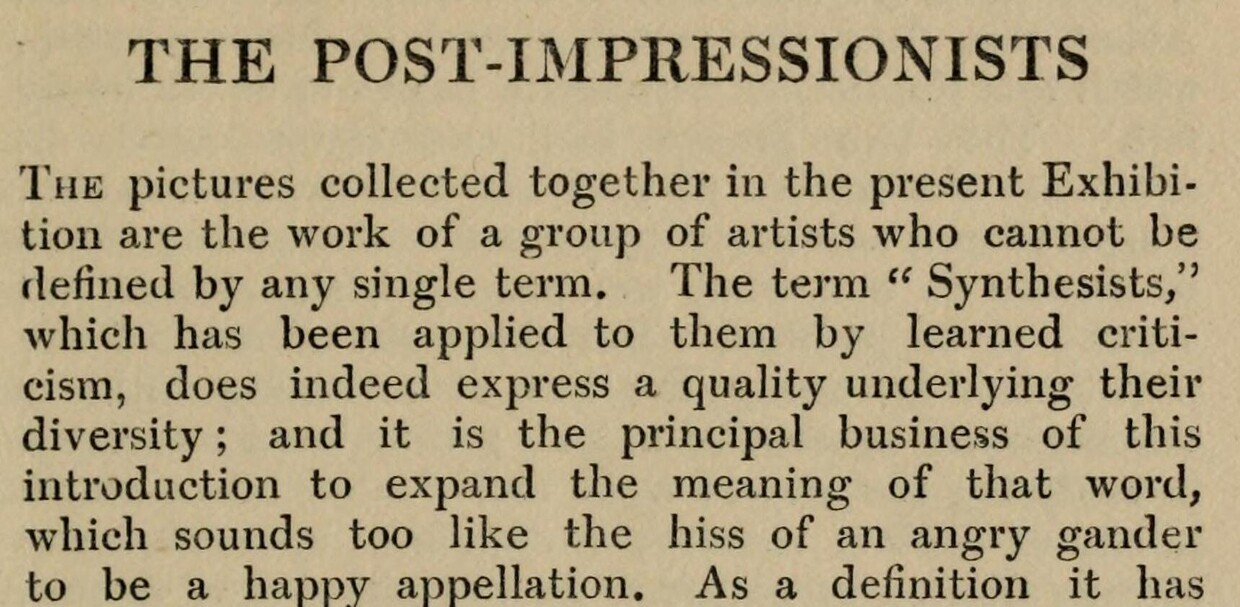
The pictures collected together in the present Exhibition are the work of a group of artists who cannot be defined by any single term. The term “Synthesists,” which has been applied to them by learned criticism, does indeed express a quality underlying their diversity ; and it is the principal business of this introduction to expand the meaning of that word, which sounds too like the hiss of an angry gander to be a happy appellation.
Thus it happened that when at the end of 1911, by a curious series of chances, I was in a position to organise an exhibition at the Grafton Galleries, I seized the opportunity to bring before the English public a selection of works conforming to the new direction. For purposes of convenience it was necessary to give these artists a name, and I chose, as being the vaguest and most non-committal, the name of Post-Impressionist. This merely stated their position in time relatively to the Impressionist movement. In conformity with my own previous prejudices against Impressionism, I think I underlined too much their divorce from the parent stock.

How it is understood today · Usus hodiernus
These artists, often working independently, are today called Post-Impressionists. Although they did not view themselves as part of a collective movement at the time, Roger Fry (1866–1934), critic and artist, broadly categorized them as “Post-Impressionists,” a term that he coined in his seminal exhibition Manet and the Post-Impressionists installed at the Grafton Galleries in London in 1910.
Exhibitions under this name

How to cite
After The Chicago Manual of Style (18th edn, 2024), in the form used in art-historical publications.
- Note
- “‘Post-Impressionism’: a conventional name,” Lacrimae Rerum Gallery, accessed 6 November 2026, https://lacrimaererum.art/peri.php?motus=1.
- Bibliography
- Lacrimae Rerum Gallery. “‘Post-Impressionism’: a conventional name.” Accessed 6 November 2026. https://lacrimaererum.art/peri.php?motus=1.