
Conventional name · Nomen placitum
‘Realism’
Réalisme
The Gallery regards the names of movements as conventions, and gives them only so that pictures may be seen beside those with which they are usually compared. Below: how the name arose and how it was received, how Champfleury withdrew from it, how it is understood today, and how it has been applied to the Gallery’s artist.
How the name arose and how it was received · Ortus
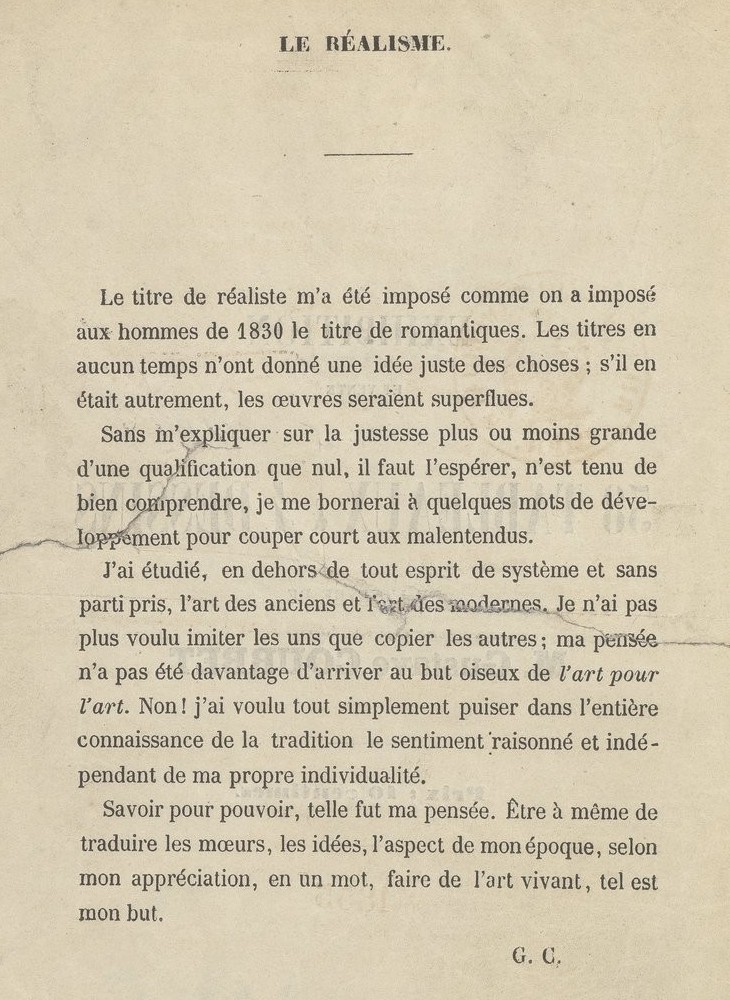
Le titre de réaliste m’a été imposé comme on a imposé aux hommes de 1830 le titre de romantiques. Les titres en aucun temps n’ont donné une idée juste des choses ; s’il en était autrement, les œuvres seraient superflues.
Sans m’expliquer sur la justesse plus ou moins grande d’une qualification que nul, il faut l’espérer, n’est tenu de bien comprendre, je me bornerai à quelques mots de développement pour couper court aux malentendus.
J’ai étudié, en dehors de tout esprit de système et sans parti pris, l’art des anciens et l’art des modernes. Je n’ai pas plus voulu imiter les uns que copier les autres ; ma pensée n’a pas été davantage d’arriver au but oiseux de l’art pour l’art. Non ! j’ai voulu tout simplement puiser dans l’entière connaissance de la tradition le sentiment raisonné et indépendant de ma propre individualité.
Savoir pour pouvoir, telle fut ma pensée. Être à même de traduire les mœurs, les idées, l’aspect de mon époque, selon mon appréciation, en un mot, faire de l’art vivant, tel est mon but.
The title of Realist was imposed on me as the title of Romantics was imposed on the men of 1830. Titles have at no time given a just idea of things; were it otherwise, works would be superfluous.
Without explaining how far this designation is accurate, which no one, it is to be hoped, is obliged to understand, I shall confine myself to a few words of elaboration, to cut short any misunderstandings.
I have studied, outside any spirit of system and without preconception, the art of the ancients and the art of the moderns. I no more wished to imitate the one than to copy the other; nor was it my thought to reach the idle goal of art for art’s sake. No! I simply wished to draw from a full knowledge of tradition the reasoned and independent sense of my own individuality.
To know in order to be able: such was my thought. To be in a position to render the manners, the ideas, and the appearance of my time according to my own judgement, in a word, to make living art: such is my aim.
Variants Les titres en aucun temps n’ont donné une idée juste des choses ;] Les titres, en aucun temps, n’ont donné une idée juste des choses : – Champfleury, Le Réalisme, 1857, p. 272, in italics · selon mon appréciation, en un mot] selon mon appréciation, être non-seulement un peintre, mais encore un homme, en un mot – Th. Silvestre, Histoire des artistes vivants (Paris, 1856), p. 266
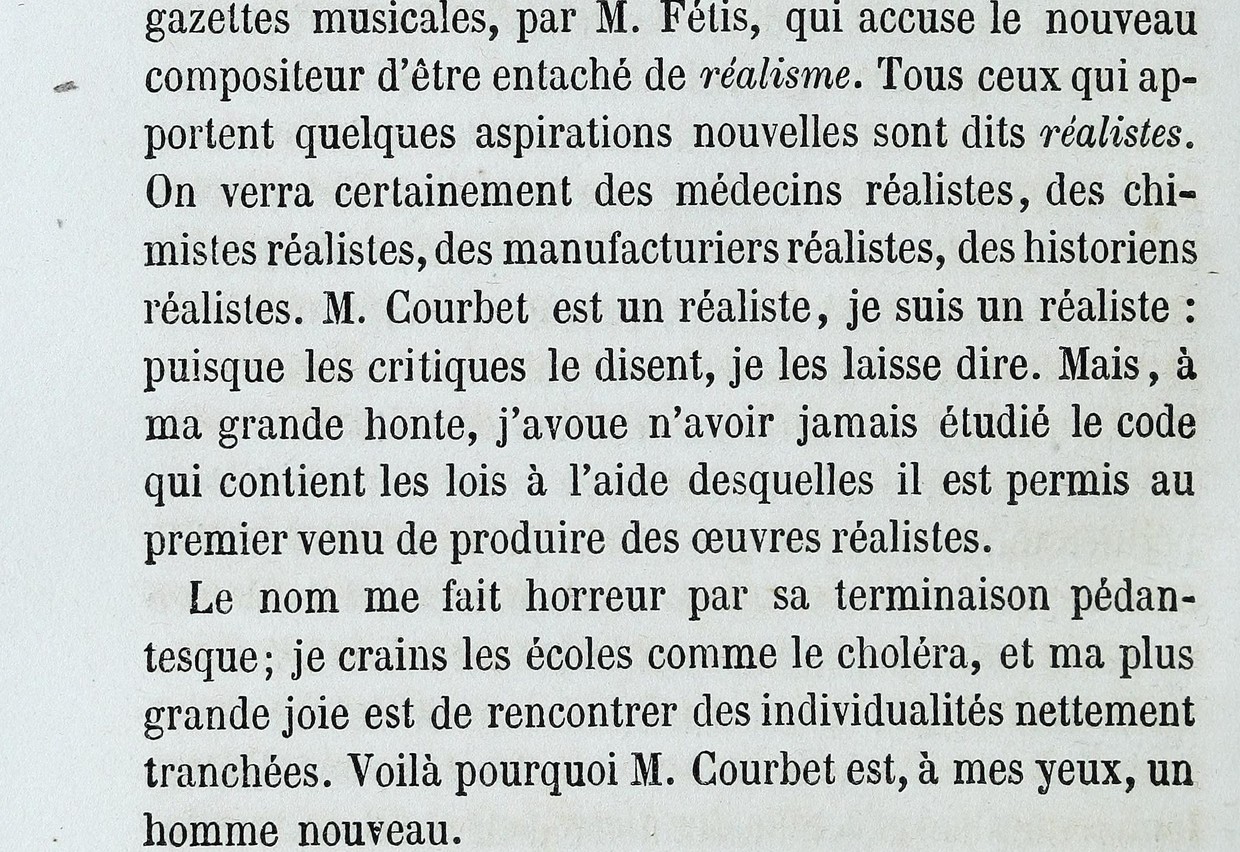
A l’heure qu’il est, madame, on voit à deux pas de l’Exposition de peinture, dans l’avenue Montaigne, un écriteau portant en toutes lettres : Du réalisme. G. Courbet. Exposition de quarante tableaux de son œuvre. …
… Tous ceux qui apportent quelques aspirations nouvelles sont dits réalistes. On verra certainement des médecins réalistes, des chimistes réalistes, des manufacturiers réalistes, des historiens réalistes. M. Courbet est un réaliste, je suis un réaliste : puisque les critiques le disent, je les laisse dire. Mais, à ma grande honte, j’avoue n’avoir jamais étudié le code qui contient les lois à l’aide desquelles il est permis au premier venu de produire des œuvres réalistes.
Le nom me fait horreur par sa terminaison pédantesque ; je crains les écoles comme le choléra, et ma plus grande joie est de rencontrer des individualités nettement tranchées. …
… Je ne vous définirai pas, madame, le réalisme ; je ne sais d’où il vient, où il va, ce qu’il est …
At this moment, madame, one can see, two steps from the exhibition of painting, on the Avenue Montaigne, a sign bearing the words in full: On Realism. G. Courbet. Exhibition of forty paintings from his work. …
… All who bring any new aspirations are called Realists. We shall assuredly see Realist doctors, Realist chemists, Realist manufacturers, Realist historians. M. Courbet is a Realist, I am a Realist: since the critics say so, I let them say it. But, to my great shame, I confess that I have never studied the code containing the laws by which the first comer is permitted to produce Realist works.
The name horrifies me by its pedantic ending; I fear schools like the cholera, and my greatest joy is to meet clearly defined individualities. …
… I shall not define Realism for you, madame; I do not know where it comes from, where it is going, or what it is …
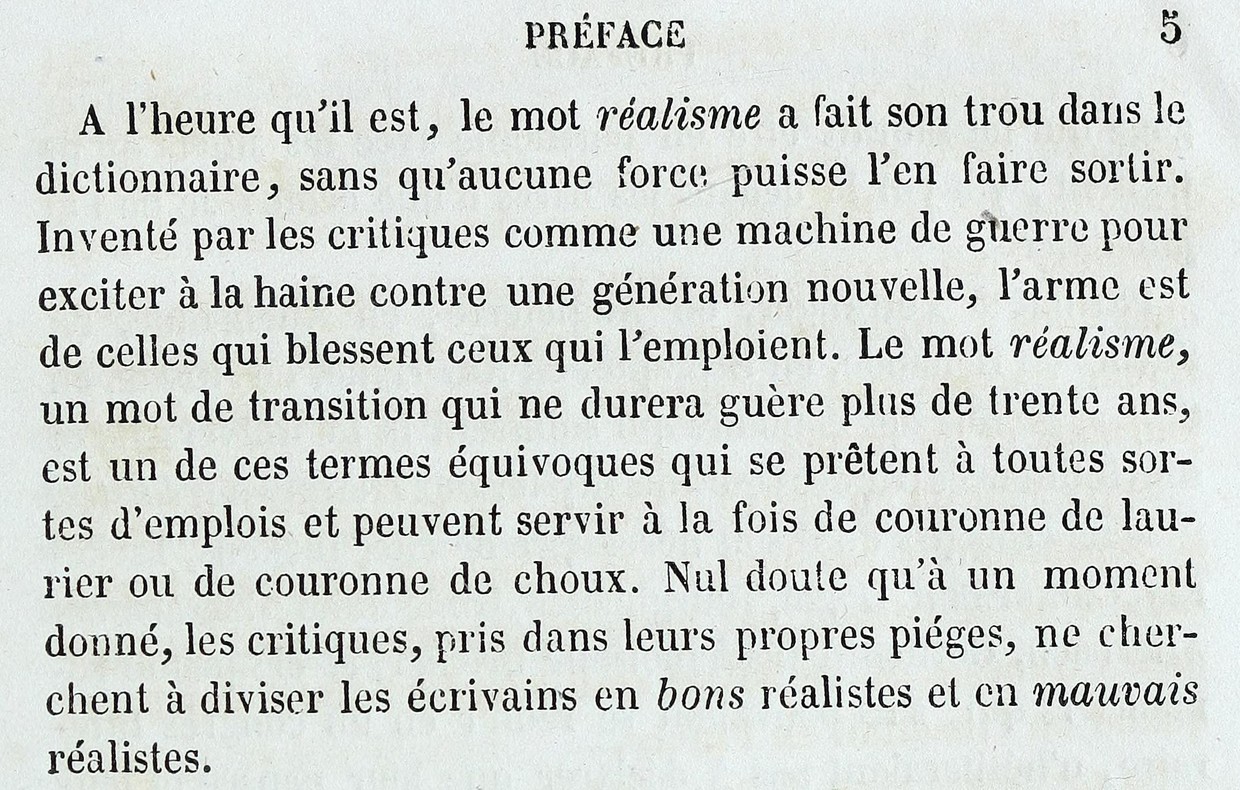
A l’heure qu’il est, le mot réalisme a fait son trou dans le dictionnaire, sans qu’aucune force puisse l’en faire sortir. Inventé par les critiques comme une machine de guerre pour exciter à la haine contre une génération nouvelle, l’arme est de celles qui blessent ceux qui l’emploient. Le mot réalisme, un mot de transition qui ne durera guère plus de trente ans, est un de ces termes équivoques qui se prêtent à toutes sortes d’emplois et peuvent servir à la fois de couronne de laurier ou de couronne de choux.
At this moment the word Realism has burrowed its way into the dictionary, and no force can drive it out. Invented by the critics as an engine of war to stir up hatred against a new generation, the weapon is of the kind that wounds those who use it. The word Realism, a word of transition that will scarcely last more than thirty years, is one of those equivocal terms that lend themselves to every sort of use and can serve at once as a crown of laurel or a crown of cabbage.
How Champfleury withdrew from it · Recessus
Je n’aime pas les écoles, je n’aime pas les drapeaux, je n’aime pas les systèmes, je n’aime pas les dogmes ; il m’est impossible de me parquer dans la petite église du réalisme, dussé-je en être le dieu.
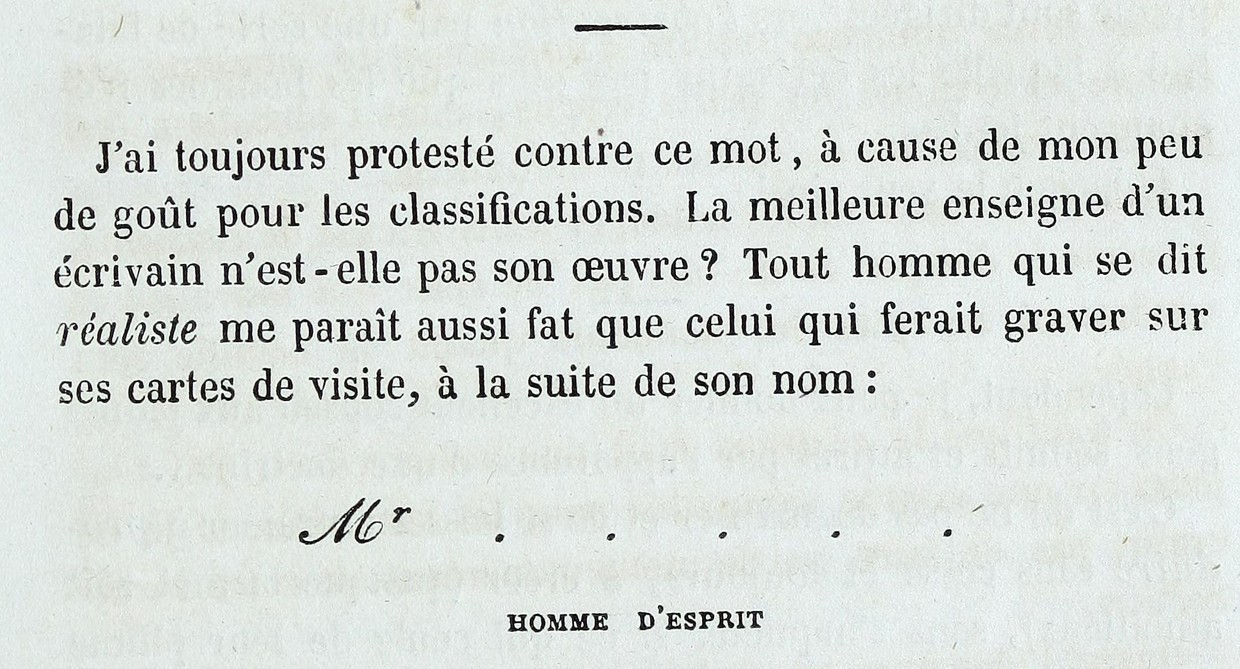
J’ai toujours protesté contre ce mot, à cause de mon peu de goût pour les classifications. La meilleure enseigne d’un écrivain n’est-elle pas son œuvre ? Tout homme qui se dit réaliste me paraît aussi fat que celui qui ferait graver sur ses cartes de visite, à la suite de son nom : Mr . . . . . homme d’esprit.
I do not like schools, I do not like flags, I do not like systems, I do not like dogmas; it is impossible for me to pen myself up in the little church of Realism, even were I to be its god.
I have always protested against this word, from my small taste for classifications. Is not a writer’s best signboard his work? Any man who calls himself a Realist seems to me as much a coxcomb as one who had engraved on his visiting cards, after his name: ‘Mr . . . . . man of wit.’
How it is understood today · Usus hodiernus
The Realist movement in French art flourished from about 1840 until the late nineteenth century, and sought to convey a truthful and objective vision of contemporary life. …
… Rejecting the idealized classicism of academic art and the exotic themes of Romanticism, Realism was based on direct observation of the modern world.
More and more, during my research, I felt that the term Realism has a very limited reach. It may be a valid label for Courbet, strictly speaking, due to the Stonebreakers (1849, formerly Dresden, destroyed in World War II) and The Burial at Ornans (1850, Musée d’Orsay …), which he considered to be the “exposé of his principles,” to the first time he used the word “Realism” (1851), and to his Manifesto of Realism (1855), which is echoed in some of his statements and works of 1861, 1863, and 1867. As for the entire rest of his career, the label might have been useful to provoke the attention of the crowd, after it had reached the mass media. One might even say that it has been imposed on Courbet, and this is why I gave it up early.
How it has been applied to the Gallery’s artist · Nomen impositum
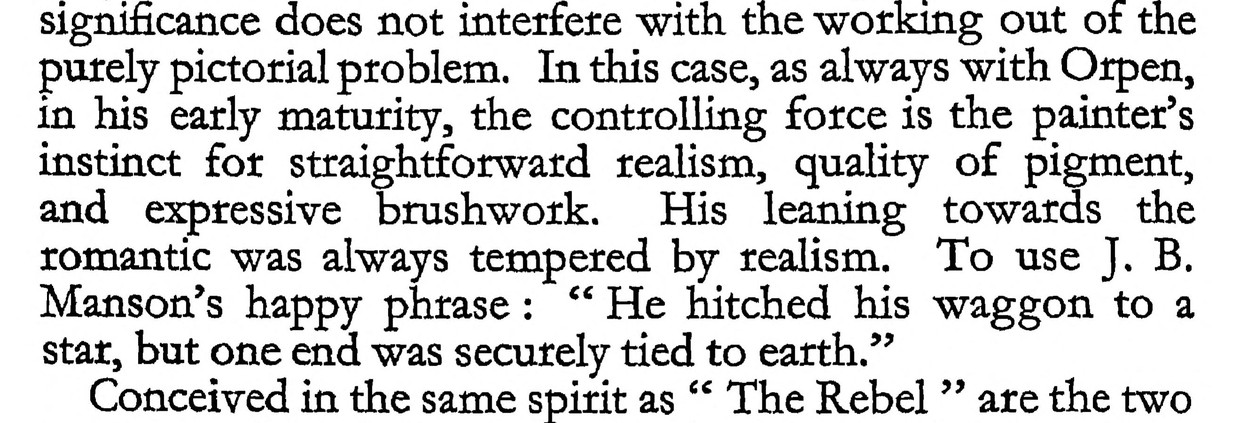
… In this case, as always with Orpen, in his early maturity, the controlling force is the painter’s instinct for straightforward realism, quality of pigment, and expressive brushwork. His leaning towards the romantic was always tempered by realism. To use J. B. Manson’s happy phrase: “He hitched his waggon to a star, but one end was securely tied to earth.”
Orpen was a realist. He was certainly not a materialist. He had an odd sort of religious feeling, indefinite, ill-defined, but real and vital.

“An artist’s duty,” he said, “is not to paint what is pleasant, but what is true.”

Exhibitions under this name

How to cite
After The Chicago Manual of Style (18th edn, 2024), in the form used in art-historical publications.
- Note
- “‘Realism’: a conventional name,” Lacrimae Rerum Gallery, accessed 6 November 2026, https://lacrimaererum.art/peri.php?motus=3.
- Bibliography
- Lacrimae Rerum Gallery. “‘Realism’: a conventional name.” Accessed 6 November 2026. https://lacrimaererum.art/peri.php?motus=3.