Exhibition · Supplementary material · Quaestio
A Puzzling Question
Herbert James Draper · Ulysses and the Sirens, 1909 · LR 9.12 · exhibition What Song the Syrens Sang
Work · Opus
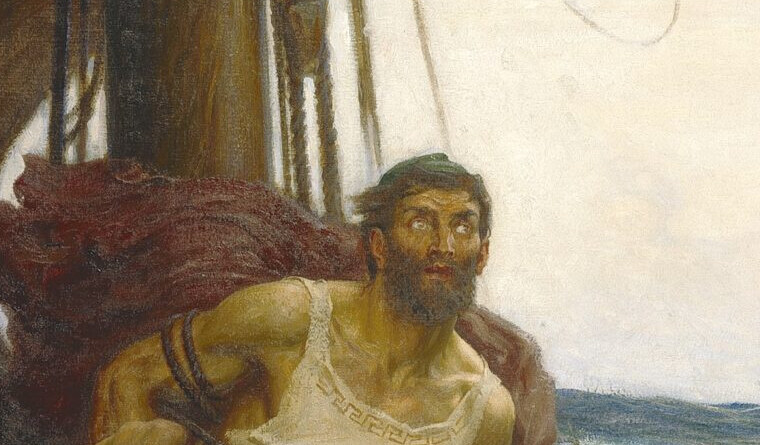
- First shown
- Royal Academy, London, 1909, Gallery No. IV, no. 206
- Collection
- Ferens Art Gallery, Hull; bought from the artist in 1910 (Hull Museums Collections)
- Question
- In Homer the Sirens have no shape and sit in a meadow. In the picture three of them come to the ship, and one has the tail of a fish. Whose Sirens are they?
- Witnesses
- A Greek vase in the British Museum; Waterhouse’s picture of 1891; two English bestiaries of the thirteenth century; Suetonius in Holland’s English; Bartholomew the Englishman; Thomas Browne; Jane Ellen Harrison; a notice of 1909; Hull Museums
The question · Quaestio
The exhibition has its title from a sentence that Thomas Browne printed in 1658.
What Song the Syrens sang, or what name Achilles assumed when he hid himself among women, though puzling Questions are not beyond all conjecture.
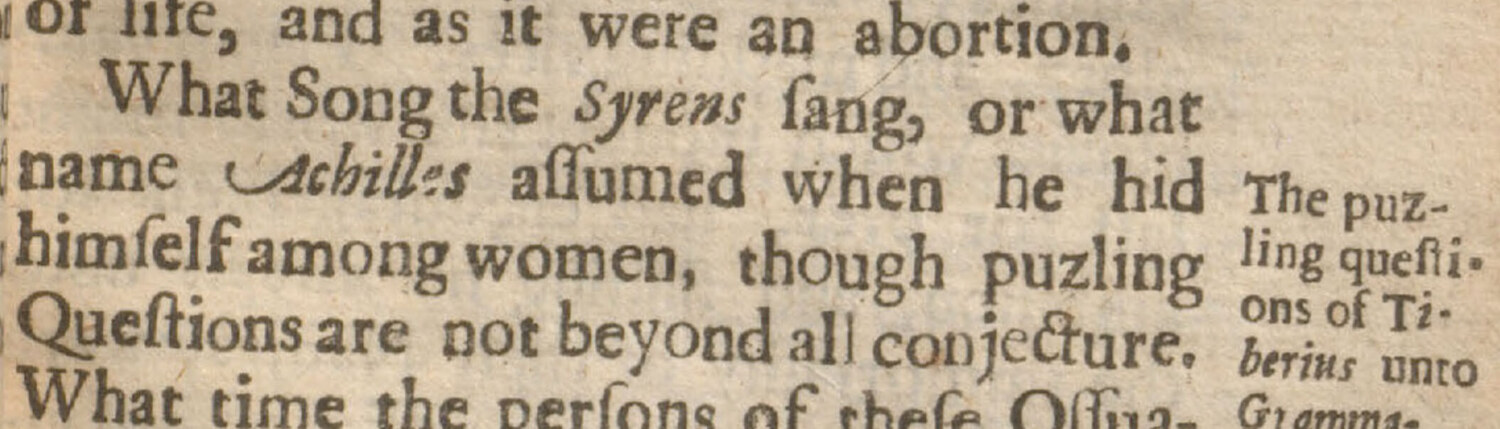
Browne took the question from Suetonius. The emperor Tiberius, Suetonius says, used to try the grammarians with three questions of this kind, and the third was what the Sirens used to sing. Philemon Holland put Suetonius into English in 1606, and where the Latin has Sirenes he wrote ‘Mer-maides’.
Maxime tamen curavit notitiam historiae fabularis usque ad ineptias atque derisum; nam et grammaticos, quod genus hominum praecipue, ut diximus, appetebat, eius modi fere quaestionibus experiebatur, quae mater Hecubae, quod Achilli nomen inter virgines fuisset, quid Sirenes cantare sint solitae?
But above all he studied for the knowledge of fabulous historie, even unto meere fooleries, and matters ridiculous. For, the verie Grammarians (which kind of professours as we have said, he affected especially) he would assay and appose commonly with these and such like questions: namely, Who was Hecubaes mother? What name Achilles had among the Virgins? What it was that the Mer-maides were wont to sing?

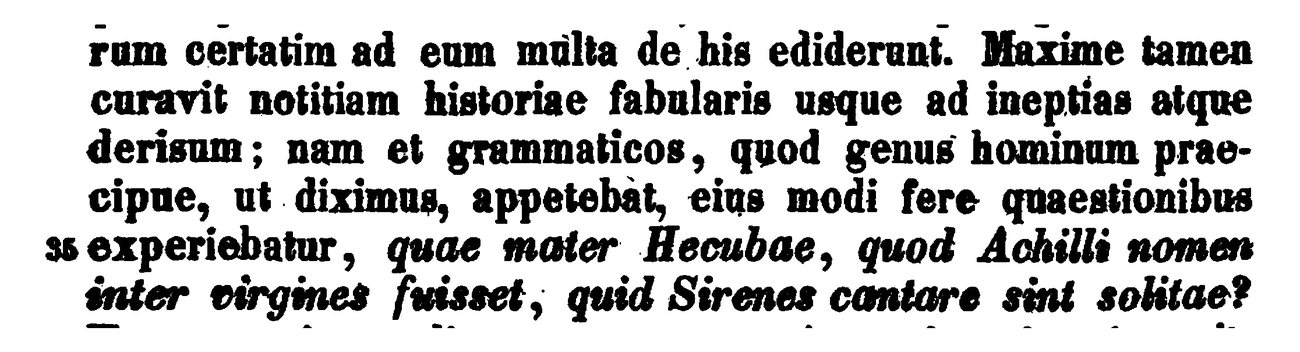
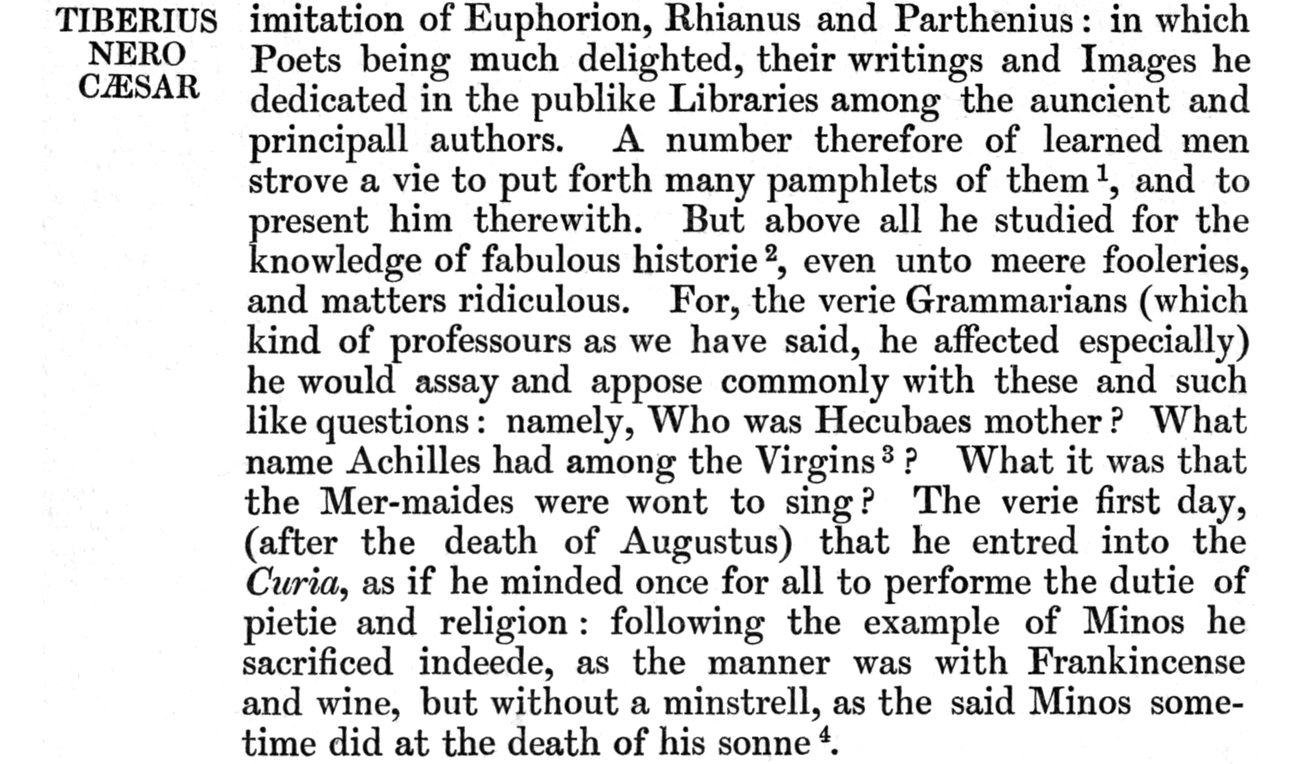
So in an English book of 1606 a Siren was already a mermaid. The museum in Hull, to which Draper’s picture belongs, says that artists usually drew the Sirens ‘as bird like figures with female heads’, and that Draper ‘depicts them as mermaids and young women’. The sections below show where each of the two shapes comes from.
The Greek shape · Forma Graeca
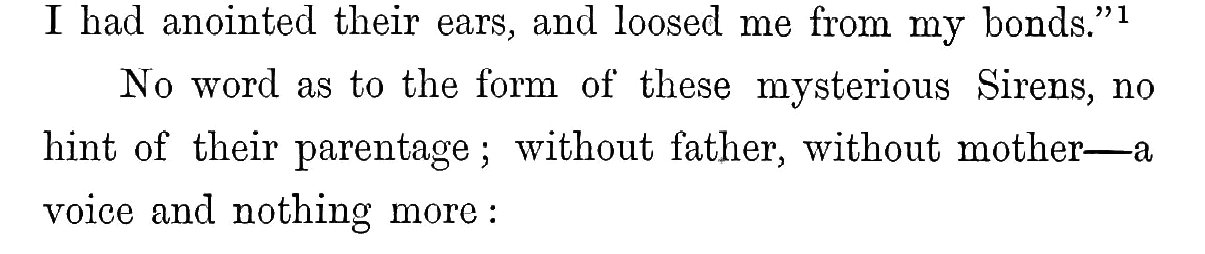
In the Odyssey the Sirens sit in a meadow and sing, and the ship goes by. Homer does not say what they look like. Jane Harrison, whose book of 1882 follows the story of Odysseus through ancient art, begins her chapter on the Sirens with this.
No word as to the form of these mysterious Sirens, no hint of their parentage; without father, without mother—a voice and nothing more…

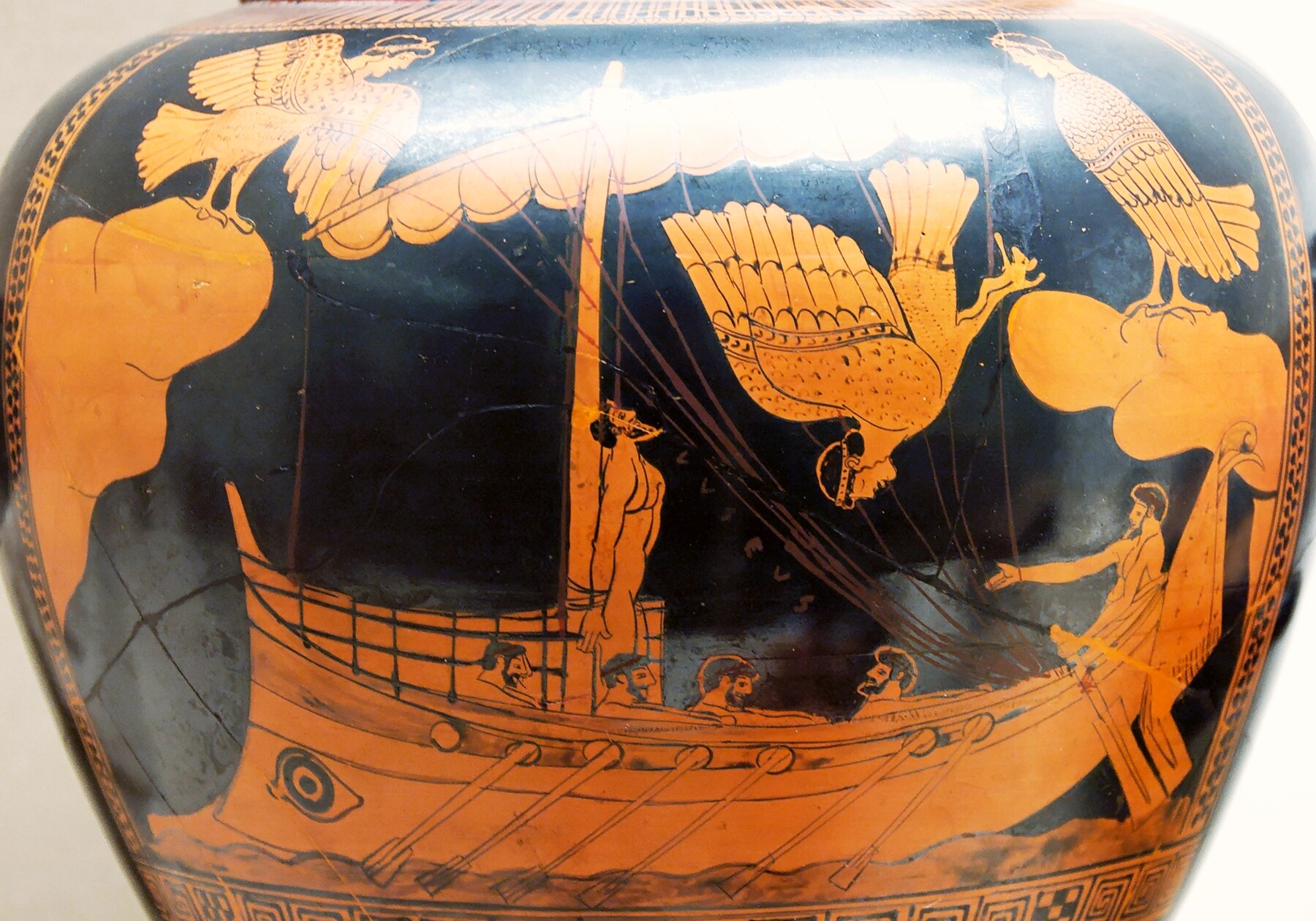
The Greek painter had to give them a body, and he gave them the body of a bird. On a jar made in Athens about 480–470 BC, found at Vulci and now in the British Museum, Odysseus stands bound to the mast. Two Sirens sit on the rocks, and a third flies down to the ship. Harrison calls this vase ‘our first art presentation’ of the story and draws it in her Plate 37: ‘The Sirens are represented with the bodies of birds and large claws’.

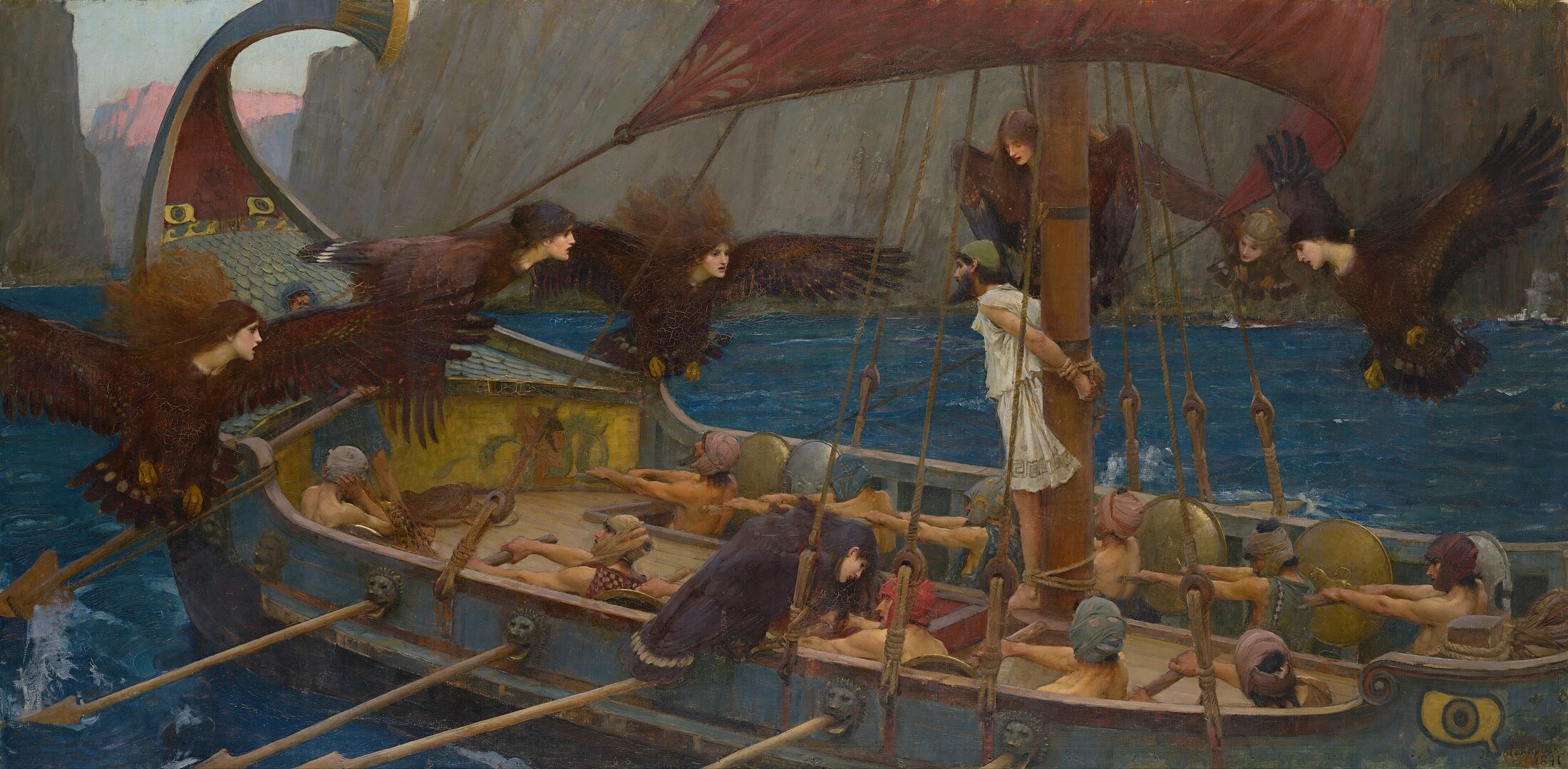
Eighteen years before Draper’s picture the Royal Academy saw this shape on canvas. In 1891 J. W. Waterhouse showed there his Ulysses and the Sirens (no. 475). The National Gallery of Victoria in Melbourne, which bought the picture from the painter that year, writes: ‘John William Waterhouse has depicted each siren with the body of a bird and the head of a beautiful woman. He borrowed the motif from an ancient Greek vase in the British Museum, London.’

The English shape · Forma Anglica
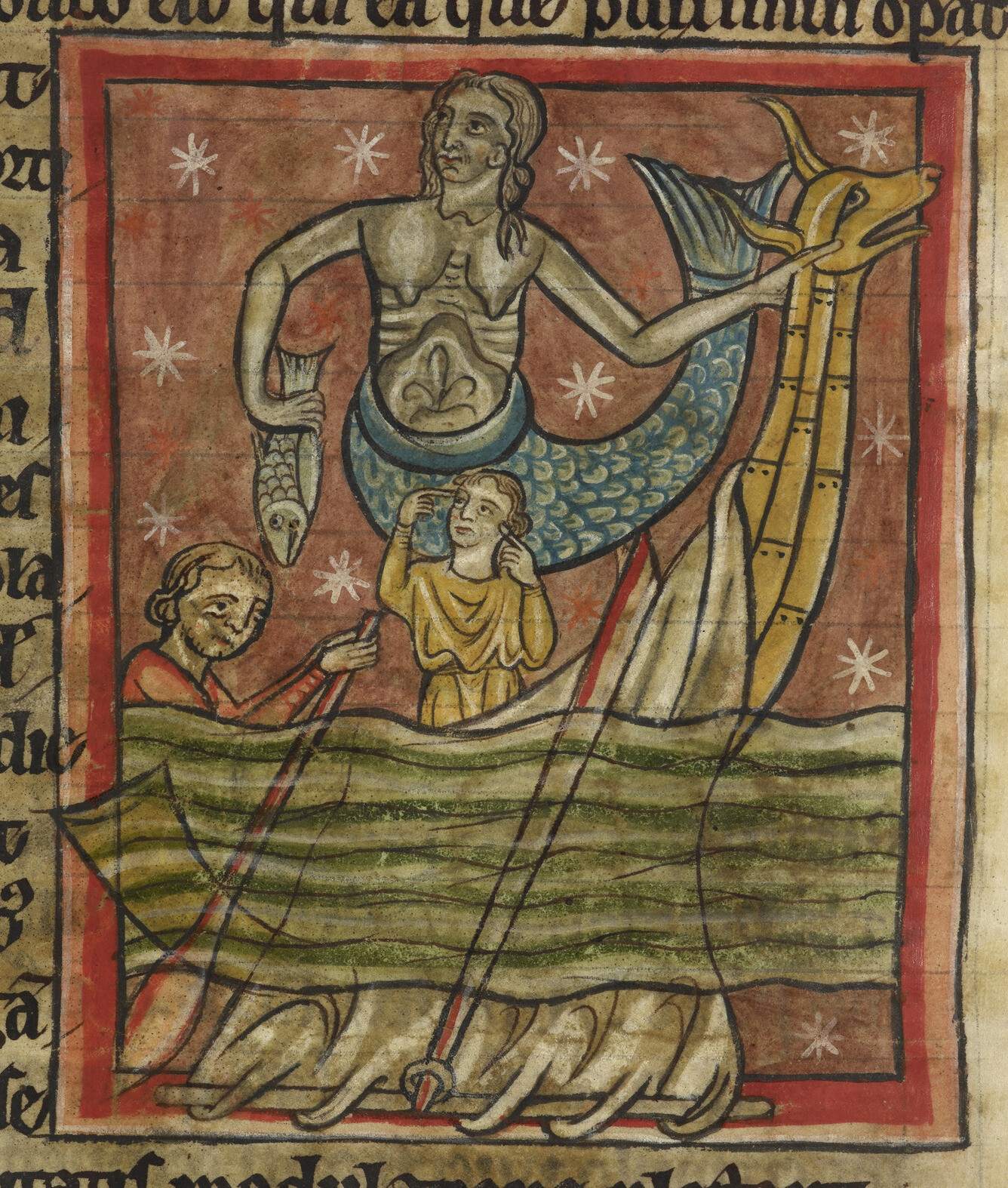
English books and English painters knew another Siren. The bestiary that Philippe de Thaon wrote for the queen of Henry I, probably soon after 1121, gives her ‘the make of a woman down to the waist, and the feet of a falcon, and the tail of a fish’ (in the English of Thomas Wright’s edition, 1841, p. 98). A bestiary painted in England about 1230–1240 shows her without the falcon’s feet. She is a woman to the waist and a fish below, she has risen over a boat with a fish in her hand, and one of the sailors stops his ears with his fingers.

A companion manuscript of the same years, now in the Bodleian Library, comes still nearer to the picture of 1909. Here there are three Sirens. They have the tails of fish, and they are in the water at the side of the ship. The sailors are asleep, and the Siren in the middle has laid her hands on the gunwale. The text beneath begins: Syrene sicut dicit phisiologus mortifera sunt animalia, that is, ‘The Sirens, as Physiologus says, are deadly creatures’.
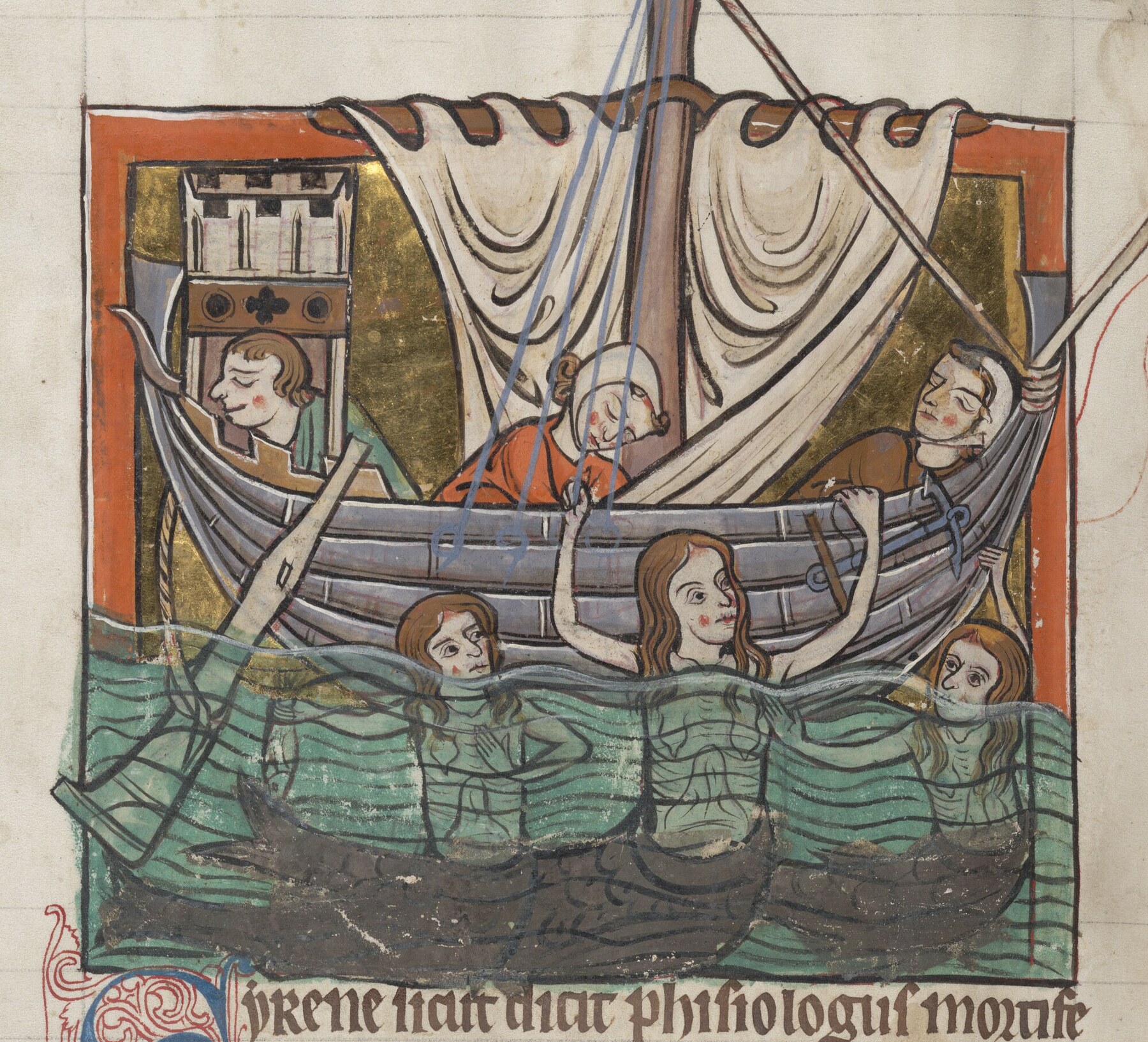
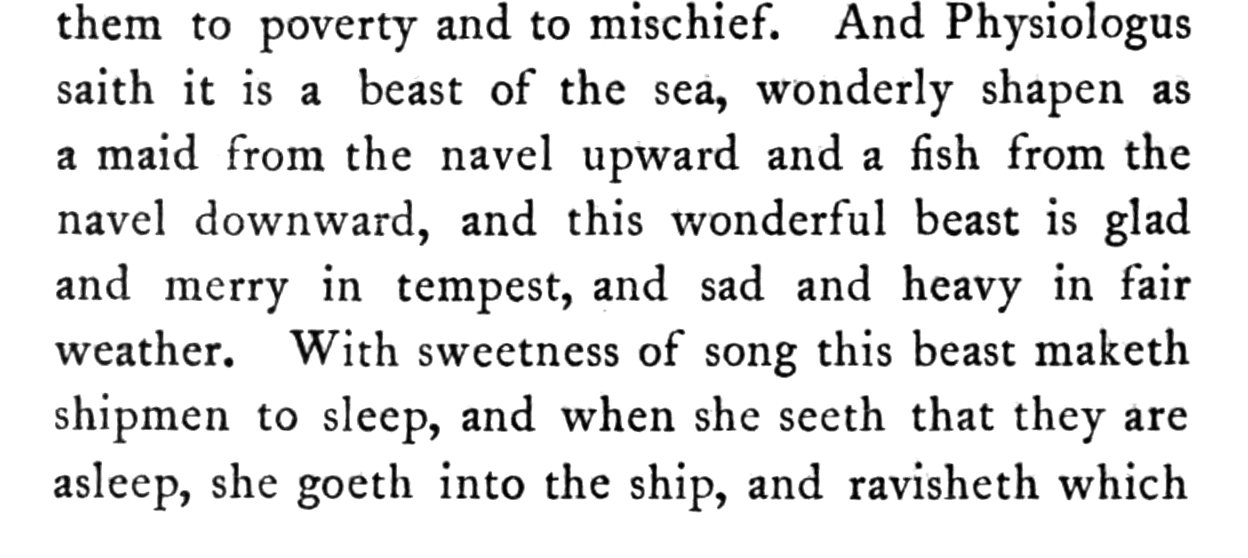
What the miniature shows, Bartholomew the Englishman tells in words. He wrote in the same century; John Trevisa put his book into English in 1397, and Robert Steele printed this chapter again in London in 1905, four years before Draper’s picture was shown.
And Physiologus saith it is a beast of the sea, wonderly shapen as a maid from the navel upward and a fish from the navel downward, and this wonderful beast is glad and merry in tempest, and sad and heavy in fair weather. With sweetness of song this beast maketh shipmen to sleep, and when she seeth that they are asleep, she goeth into the ship…

The poets kept this shape. In Gower, about 1390, the Sirens are ‘like unto women of yonge age’ from the navel upward, and below ‘they bere of fisshes the figure’ (they bear the figure of fishes); the Latin note in his margin gives the story to Ulysses. Spenser in 1590 calls them ‘Mermayds’ and tells how half of each was ‘transform’d to fish’ (book II, canto XII). Holland’s ‘Mer-maides’ of 1606 are these Sirens.
The two shapes compared · Collatio
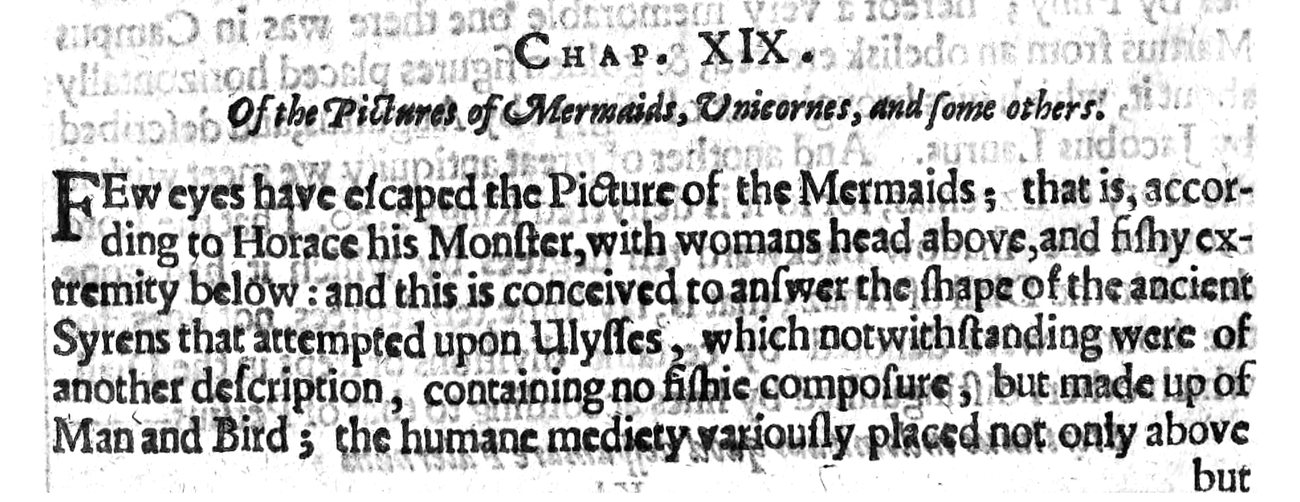
That one shape had been taken for the other was seen in England long before 1909. Twelve years before he asked what song the Sirens sang, Browne opened his chapter on the pictures of mermaids with this.
Few eyes have escaped the Picture of the Mermaids; that is, according to Horace his Monster, with womans head above, and fishy extremity below: and this is conceived to answer the shape of the ancient Syrens that attempted upon Ulysses, which notwithstanding were of another description, containing no fishie composure, but made up of Man and Bird; the humane mediety variously placed not only above but below…

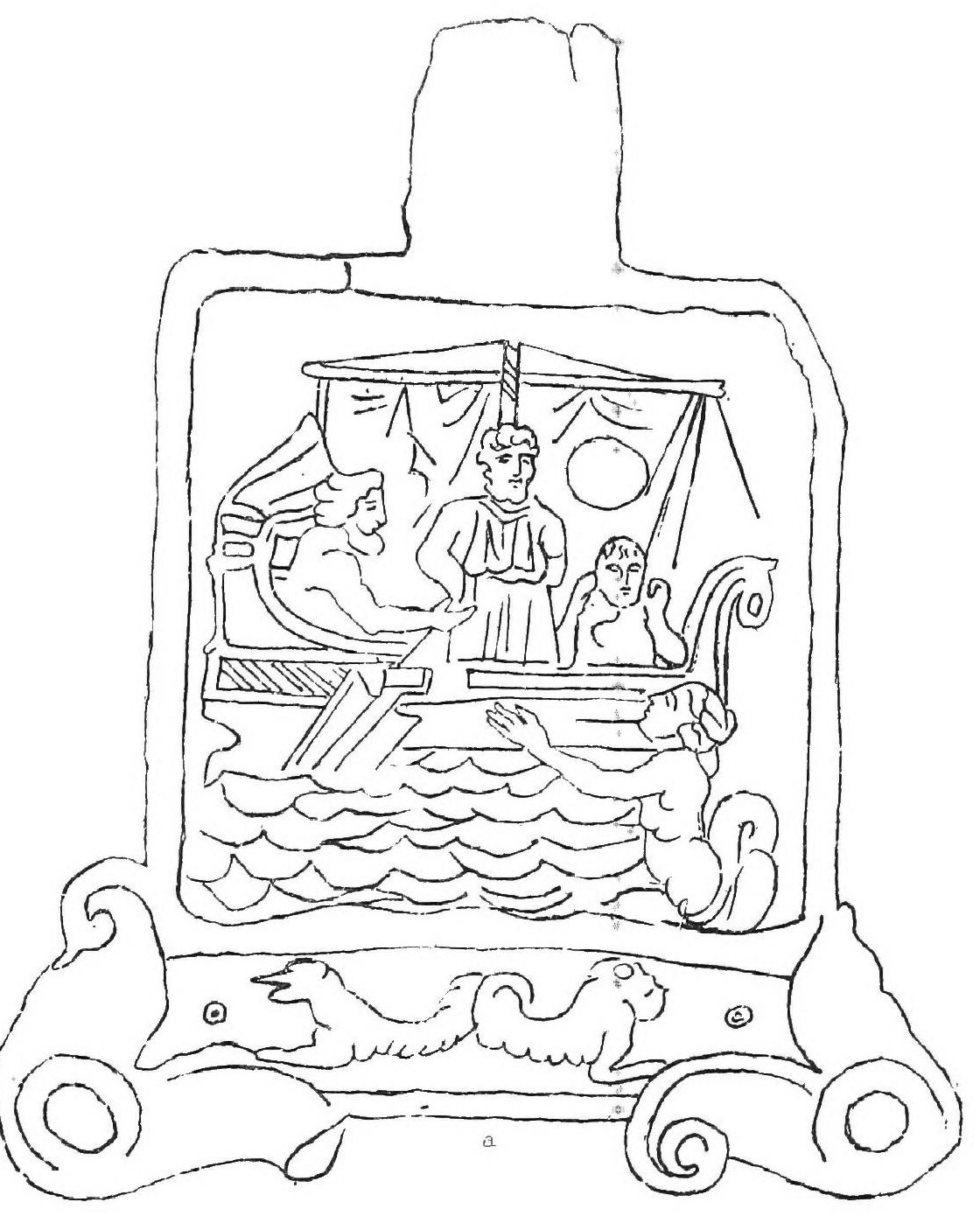
Harrison in 1882 set the two shapes in order of time. The bird belongs to the Greeks, and of the fish she writes: ‘On the whole we should incline to think that the fish form is characteristic of mediæval times.’ In this way, she says, ‘we find the Siren transformed into the modern mermaid’. She knew one exception, a terra-cotta lamp kept at Canterbury, on which Odysseus in his boat passes a single Siren: ‘in it alone of all works with any claim to antiquity the Siren has a fish’s tail’. For the fish she calls the same English witness as this page, and quotes Gower’s lines herself.
At the Academy, 1909 · Academia
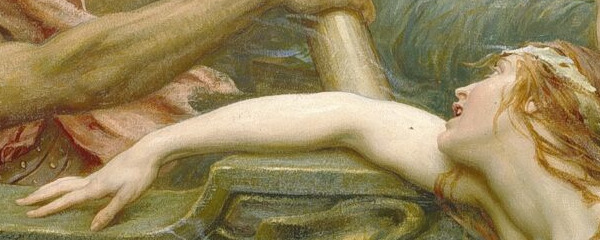
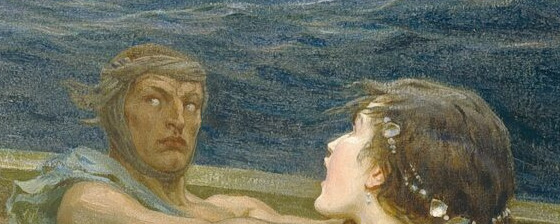
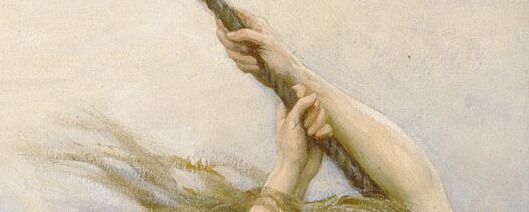
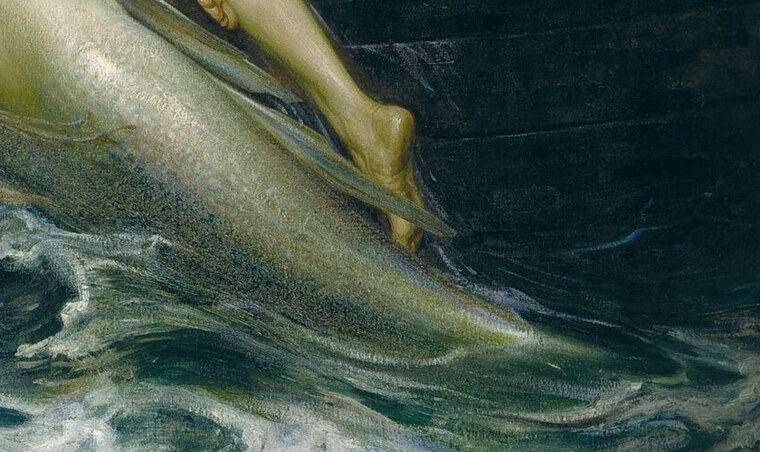
In 1909 Draper’s picture hung in Gallery No. IV of the Royal Academy as no. 206 (catalogue, p. 15). Its three Sirens have come to the ship. The first has the tail of a fish and lays her arm along the gunwale. The second has feet; she is coming over the side, face to face with a rower. The third holds a rope at the stern.
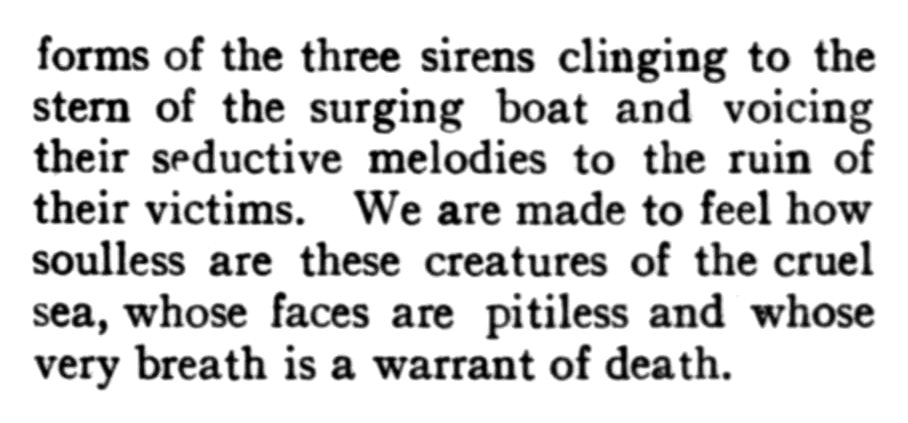
One notice of that summer found the weight of the picture in these three figures.
…but the emphasis of the picture lies in the vivid contrast between these normal human figures and the weird unearthly forms of the three sirens clinging to the stern of the surging boat and voicing their seductive melodies to the ruin of their victims.

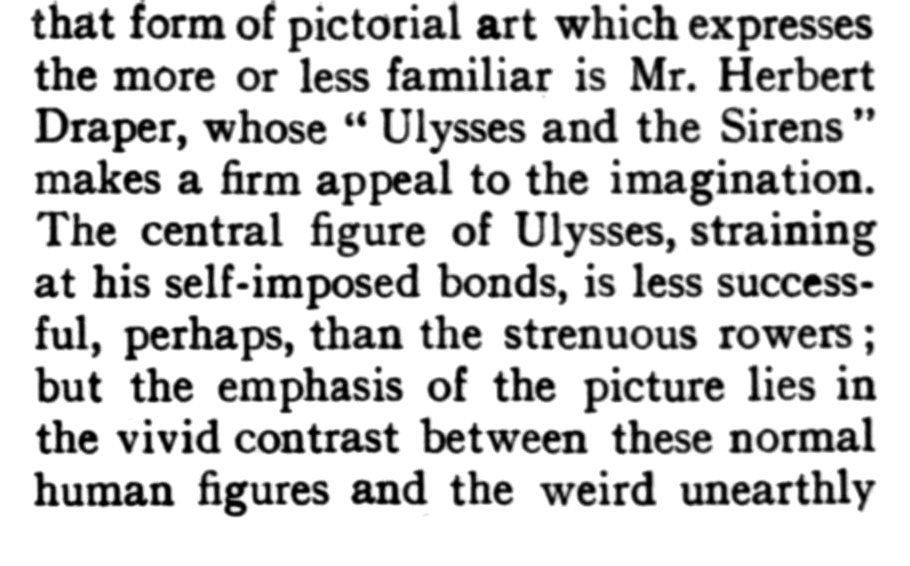
The Times judged otherwise, by the account of the museum in Hull: ‘The Times newspaper was critical because it was not faithful to Homer’s tale.’
The answer · Responsio
Homer gives the Sirens no shape. The Greek vase gives them the bodies of birds, and Waterhouse in 1891 followed the vase. That shape was within Draper’s reach: Harrison in 1882 speaks of the vase as ‘now in the British Museum’, and the museum in Hull says that Draper went to the British Museum ‘to consult contemporary artefacts’. His picture has no birds in it.
His Sirens are those of the English leaves and books. There are three of them at the side of the ship, as in the Bodleian bestiary. One has the tail of a fish, as in Philippe de Thaon, Gower and Spenser, and lays her arm on the gunwale. Another is coming on board, and in Bartholomew ‘she goeth into the ship’. Two have feet and one a tail, and Harrison had written in 1882: ‘We think of the Sirens as fair, baneful maidens, or possibly, influenced by modern art, as of mermaid shape’ (p. 150).
By these pages, the Sirens of the picture that was called unfaithful to Homer are the Sirens that English books and English painters had shown since the twelfth century. Browne, from whom the exhibition has its title, wrote of their shape in 1646 that it ‘is conceived to answer the shape of the ancient Syrens that attempted upon Ulysses’.
What we do not know: whether Draper saw these leaves or read these pages. We have found no letter or note of his that names a book or a manuscript. Simon Toll’s monograph of 2003 has not been available to us, and what is said here may already stand in it. The page of The Times we have not seen either, and its notice is given here only in the words of the museum.
Sources
All words of the sources were checked against images of the pages, not against recognised text. Books and periodicals: Internet Archive; Browne, 1658, from the copy of McGill Library, Browne, 1646, from that of the Wellcome Collection, Harrison from that of Cornell University Library. Images: the vase in the British Museum, photograph by Marie-Lan Nguyen, public domain; Waterhouse, National Gallery of Victoria, Melbourne, public domain, reproduced in full; Harley MS 4751, British Library, CC0; MS. Bodl. 764, © Bodleian Libraries, University of Oxford, CC BY-NC 4.0. Royal Academy catalogue of 1909: Paul Mellon Centre, CC BY-NC 4.0. Hull Museums Collections: the page as kept by the Wayback Machine. Read and not quoted, because none of them speaks of the shape of the Sirens: The Athenæum, 1 May 1909, pp. 534–535; The Spectator, 1 May 1909, p. 700; The Saturday Review, 22 May 1909, pp. 654–655. Not consulted: Toll, 2003; The Times, 1909.
How to cite
After The Chicago Manual of Style (18th edn, 2024), in the form used in art-historical publications.
- Note
- “A Puzzling Question: Ulysses and the Sirens. Supplementary material to the exhibition What Song the Syrens Sang,” Lacrimae Rerum Gallery, LR 9.12, accessed 14 November 2026, https://lacrimaererum.art/draper/what-song-the-syrens-sang/quaestio/.
- Bibliography
- Lacrimae Rerum Gallery. “A Puzzling Question: Ulysses and the Sirens. Supplementary material to the exhibition What Song the Syrens Sang.” LR 9.12. Accessed 14 November 2026. https://lacrimaererum.art/draper/what-song-the-syrens-sang/quaestio/.