Skip to content
LACRIMAE RERVM Gallery

Exhibition · Supplementary material · Litterae

Letters

His own words and letters for the exhibition What Song the Syrens Sang, by room: the text he gave for his picture of 1906, Leighton’s letter to him, and his letters from home. Each is set beside the page or the sheet it comes from. The words have been checked against the images; dates in square brackets are ours, and the grounds stand under each letter.

Room IV · In the Ardour of the Sun · 1898–1918

1906 · for his picture Day and the Dawn Star, Royal Academy, no. 545

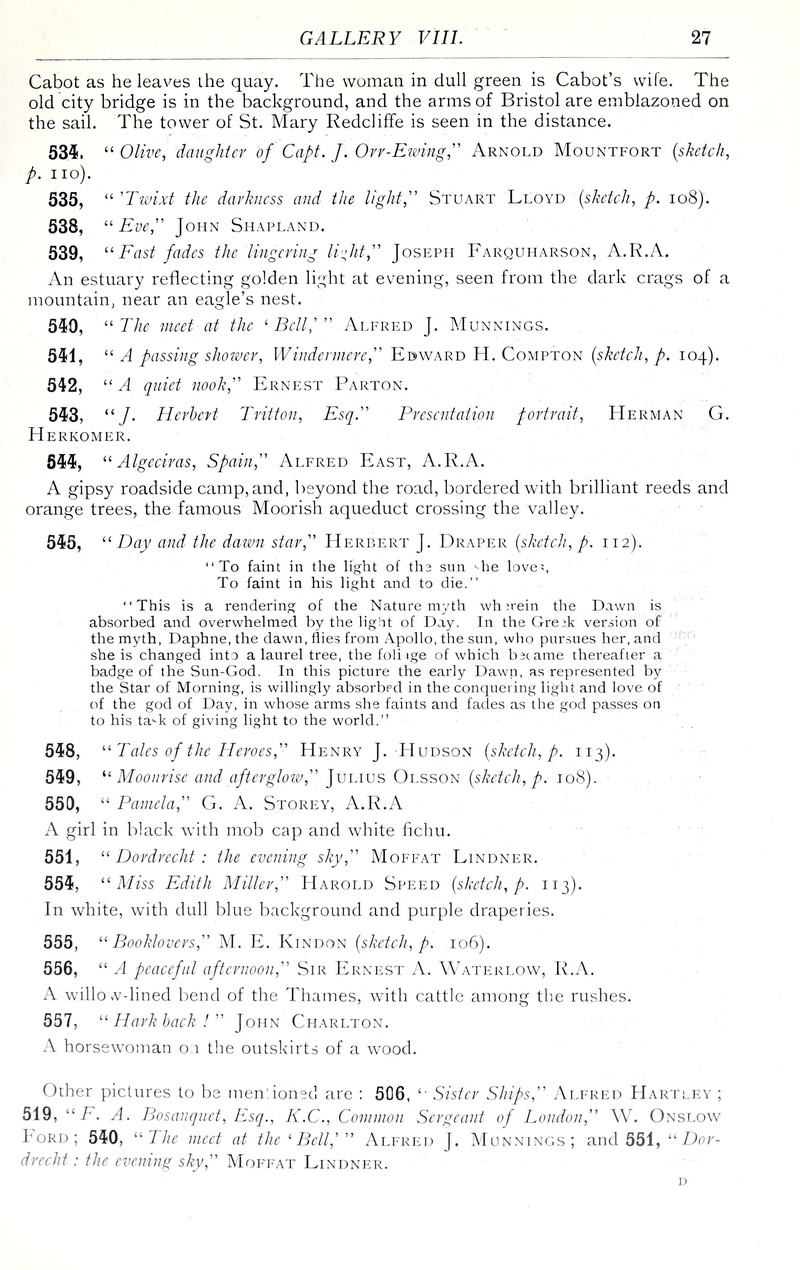
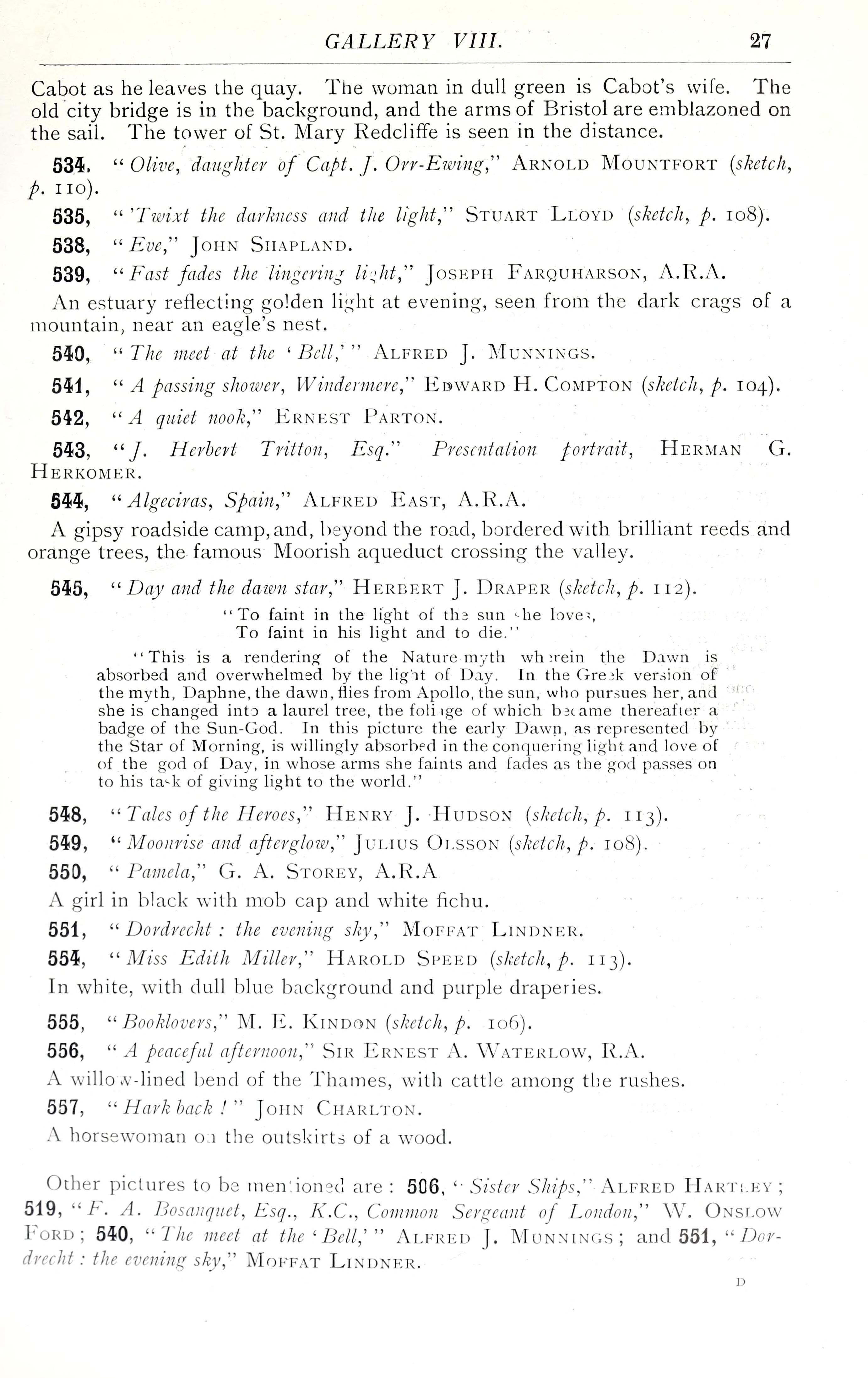
“This is a rendering of the Nature-myth wherein the Dawn is absorbed and overwhelmed by the light of Day. In the Greek version of the myth, Daphne, the dawn, flies from Apollo, the sun, who pursues her, and she is changed into a laurel tree, the foliage of which became thereafter a badge of the Sun-God. In this picture the early Dawn, as represented by the Star of Morning, is willingly absorbed in the conquering light and love of of the god of Day, in whose arms she faints and fades as the god passes on to his task of giving light to the world.”

Academy Notes, 1906, p. 27 · scan of the page

Above the text stand Tennyson’s lines, in quotation marks and without his name, as in the Academy’s catalogue (dossier); ‘of of’ is as printed. Christie’s, 25 November 2003, lot 153, quotes the first sentence as a letter from Draper to the Academy.
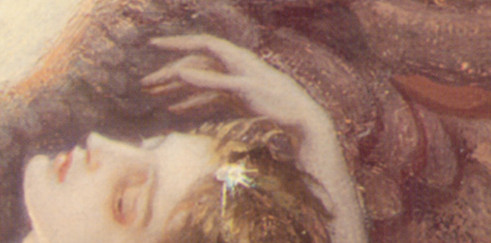
Dawn, the star in her hair: a detail of Day and the Dawn Star
Day and the Dawn Star, Royal Academy, 1906, no. 545. Private collection. Detail: Dawn, the star in her hair, from a photograph
The Mountain Mists
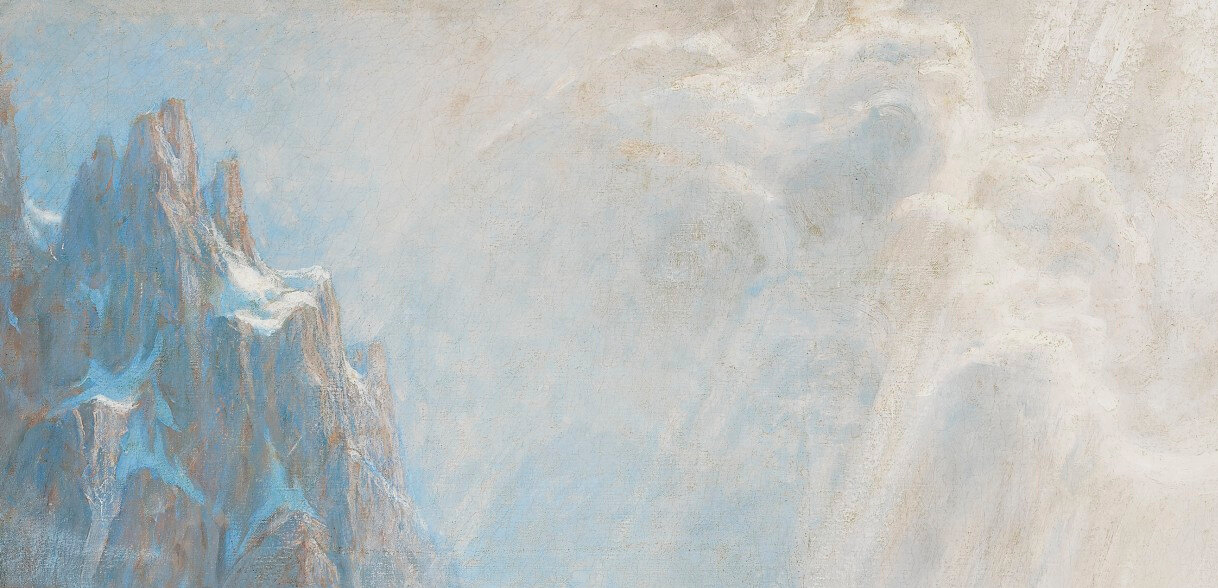
14 The Mountain Mists, 1912Six years later, in the Academy’s catalogue of 1912, it carried lines without an author’s name: ‘Like Semele the mountain mists were whelmed, / And perished in the ardour of the sun’ (dossier)
Page 27 of Academy Notes, 1906: no. 545
As printed: Academy Notes, 1906, p. 27 — Getty Research Institute copy (Internet Archive). The page at full size

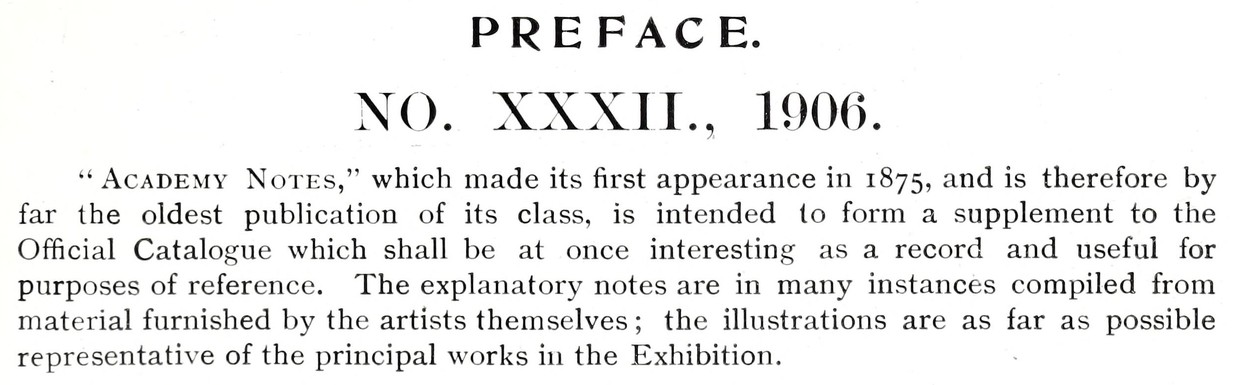
Whose words these are: the preface to the same issue

The explanatory notes are in many instances compiled from material furnished by the artists themselves;

Academy Notes, 1906, Preface, May 1906 · scanOf the notes on page 27, this is the only one set in quotation marks.
The preface to Academy Notes, 1906
As printed: Academy Notes, 1906, Preface.

Daphne as the dawn: Max Müller’s reading of the myth, fifty years earlier

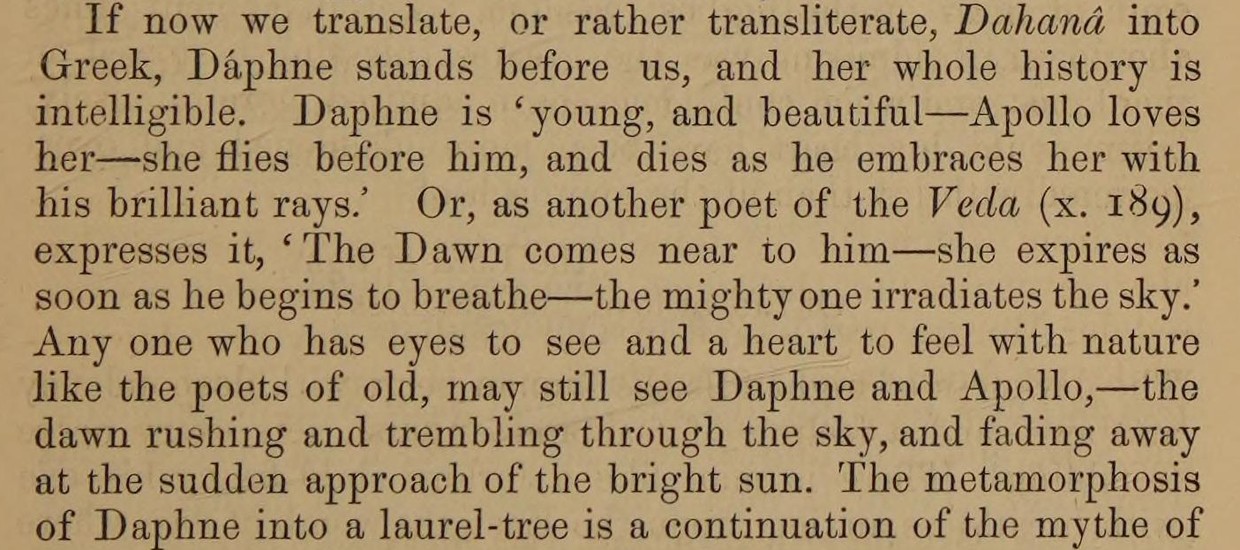
Daphne is ‘young, and beautiful—Apollo loves her—she flies before him, and dies as he embraces her with his brilliant rays.’ Or, as another poet of the Veda (x. 189), expresses it, ‘The Dawn comes near to him—she expires as soon as he begins to breathe—the mighty one irradiates the sky.’ Any one who has eyes to see and a heart to feel with nature like the poets of old, may still see Daphne and Apollo,—the dawn rushing and trembling through the sky, and fading away at the sudden approach of the bright sun.

Max Müller, ‘Comparative Mythology’, Oxford Essays (London, 1856), p. 57 · scan
Page 57 of Oxford Essays, 1856: the running head
Page 57 of Oxford Essays, 1856: Daphne and Apollo
As printed: Max Müller, ‘Comparative Mythology’, Oxford Essays (London: John W. Parker and Son, 1856), p. 57.

Room V · Home · 1899–1919

[Winter 1891–92 or spring 1892] · Lord Leighton to Draper, who had asked whether to settle in Italy

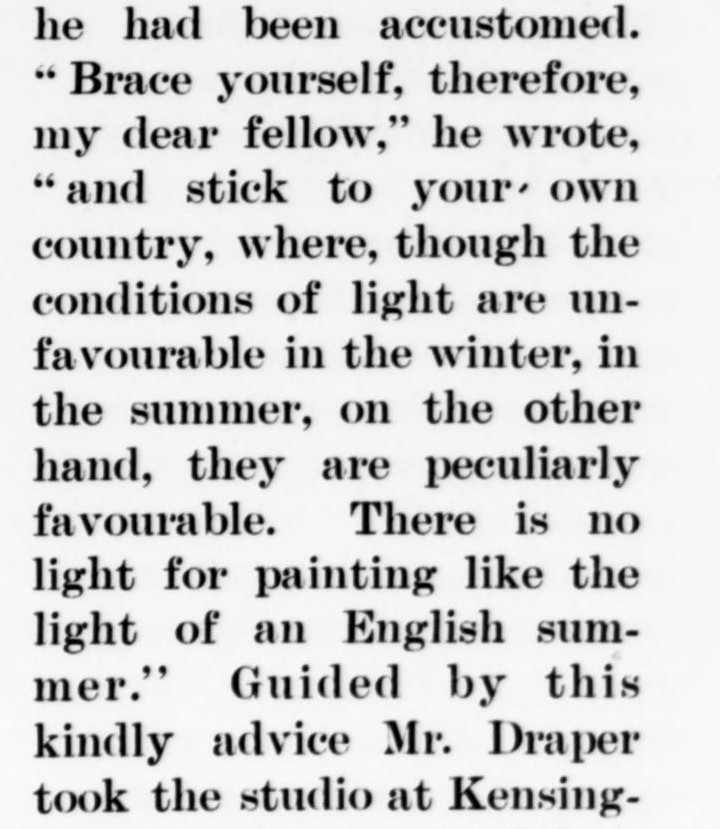
Brace yourself, therefore, my dear fellow, … and stick to your own country, where, though the conditions of light are unfavourable in the winter, in the summer, on the other hand, they are peculiarly favourable. There is no light for painting like the light of an English summer.

Known only from A. L. Baldry’s article: The Magazine of Art, December 1898, p. 51 · scan of the page

The date is Baldry’s order of events: Draper spent the winter of 1891–92 in Rome and painted there a picture for the Academy of 1892; ‘before coming to a final decision on the question of life abroad’ he asked Leighton, and on this advice took a studio in Kensington, whose address is printed in the Academy’s catalogue of 1892 (Places). His only work that year was no. 891, Love in the garden of Philetas (Academy Notes, 1892, p. 22). The last sentence is the room’s epigraph. ‘…’ stands for Baldry’s ‘he wrote’.

Room V ‘Home’, 1899–1919: four works

Page 51 of The Magazine of Art: Lord Leighton’s letter
As printed: A. L. Baldry, ‘Our Rising Artists: Mr. Herbert J. Draper’, The Magazine of Art, vol. 23 (1899), p. 51.

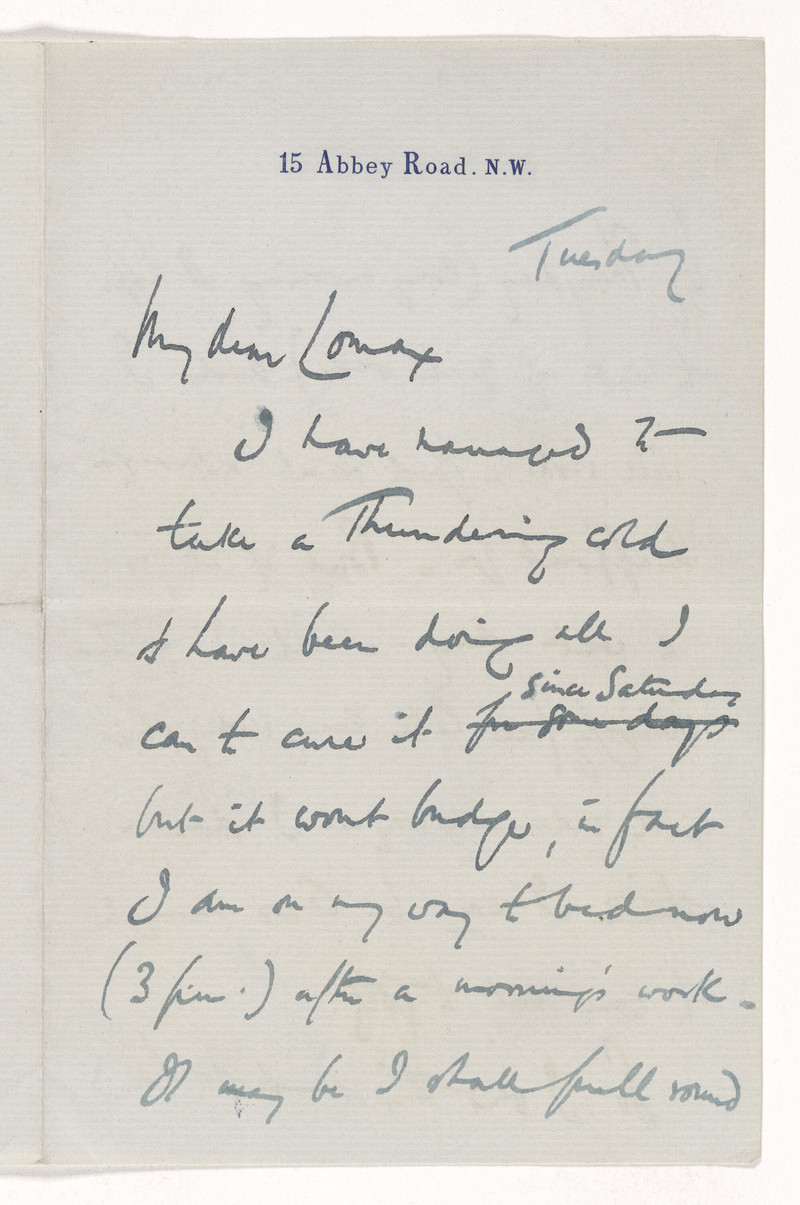
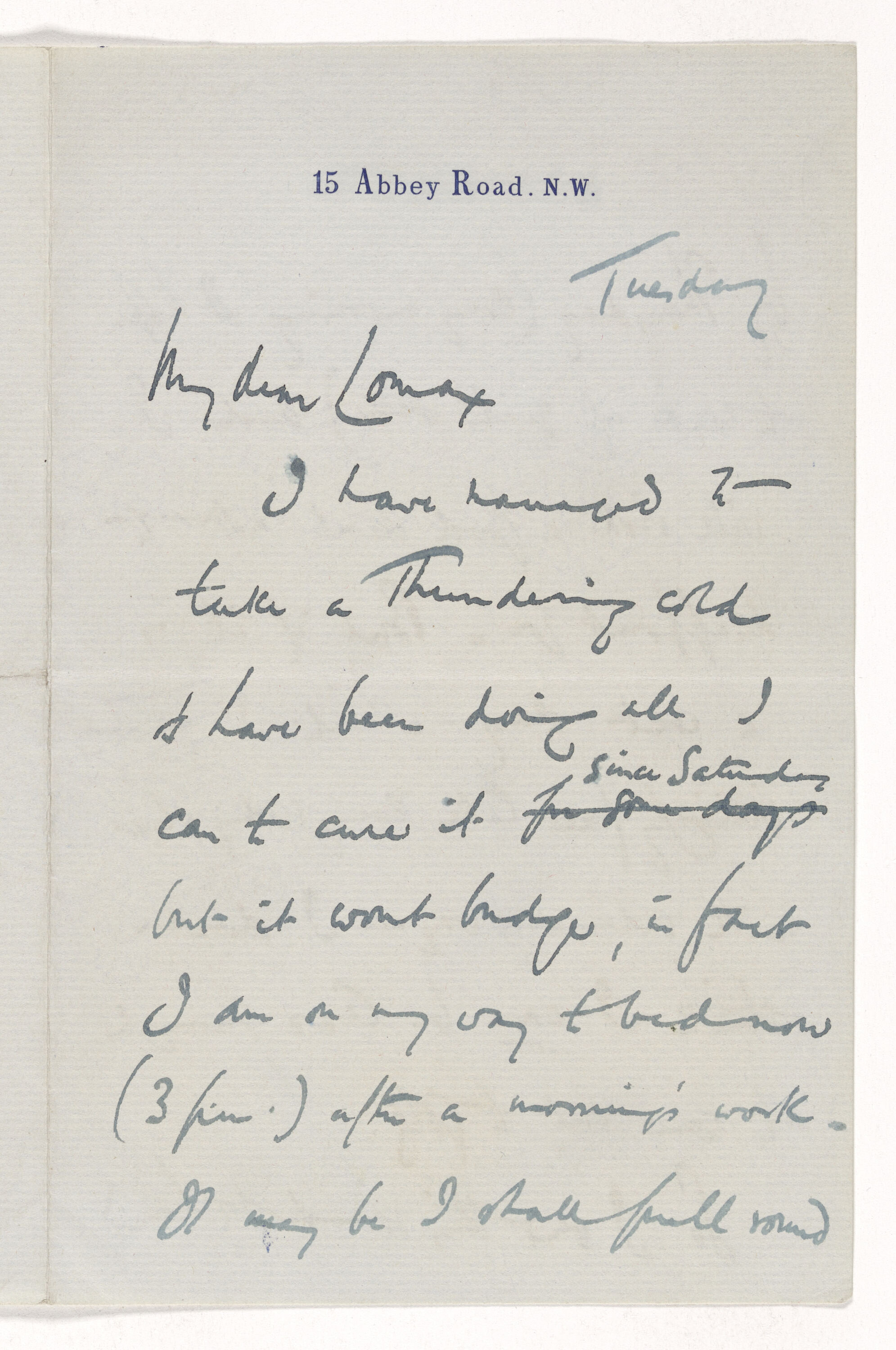
15 Abbey Road, Tuesday [20 October 1903?] · to John Arthur Lomax, painter

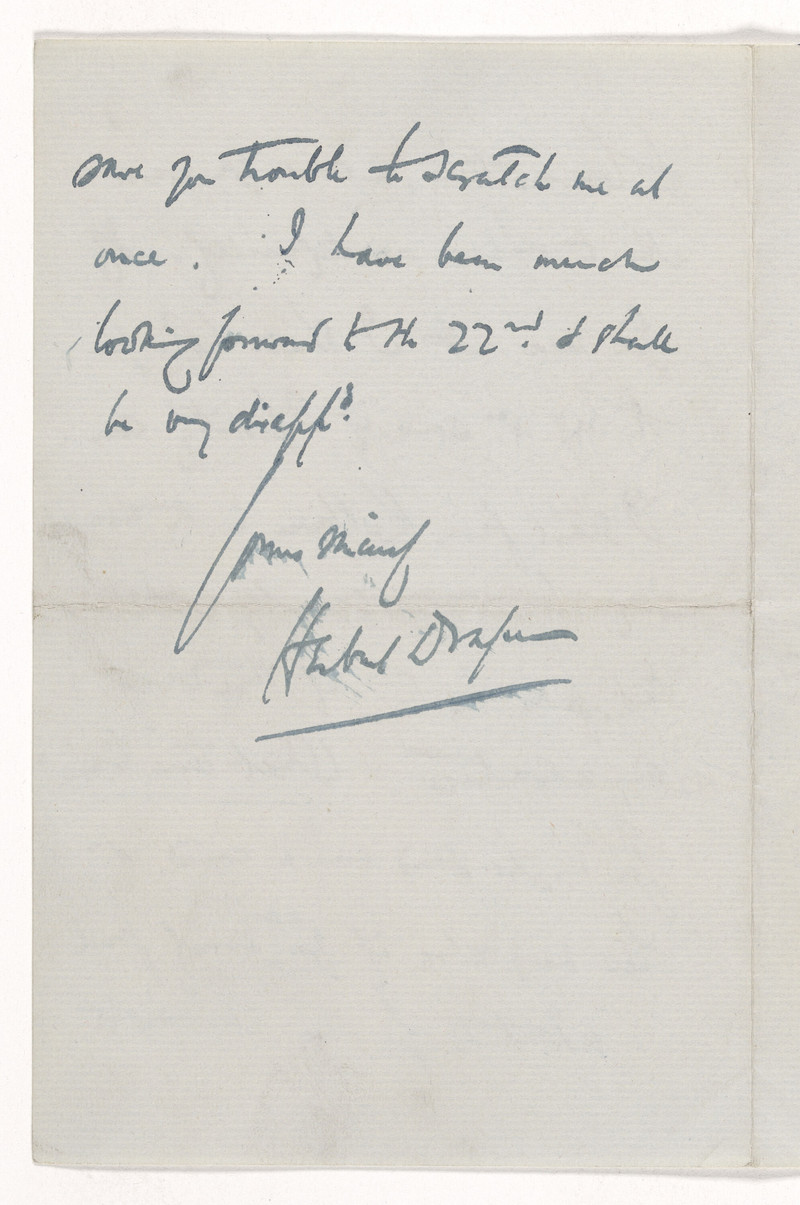
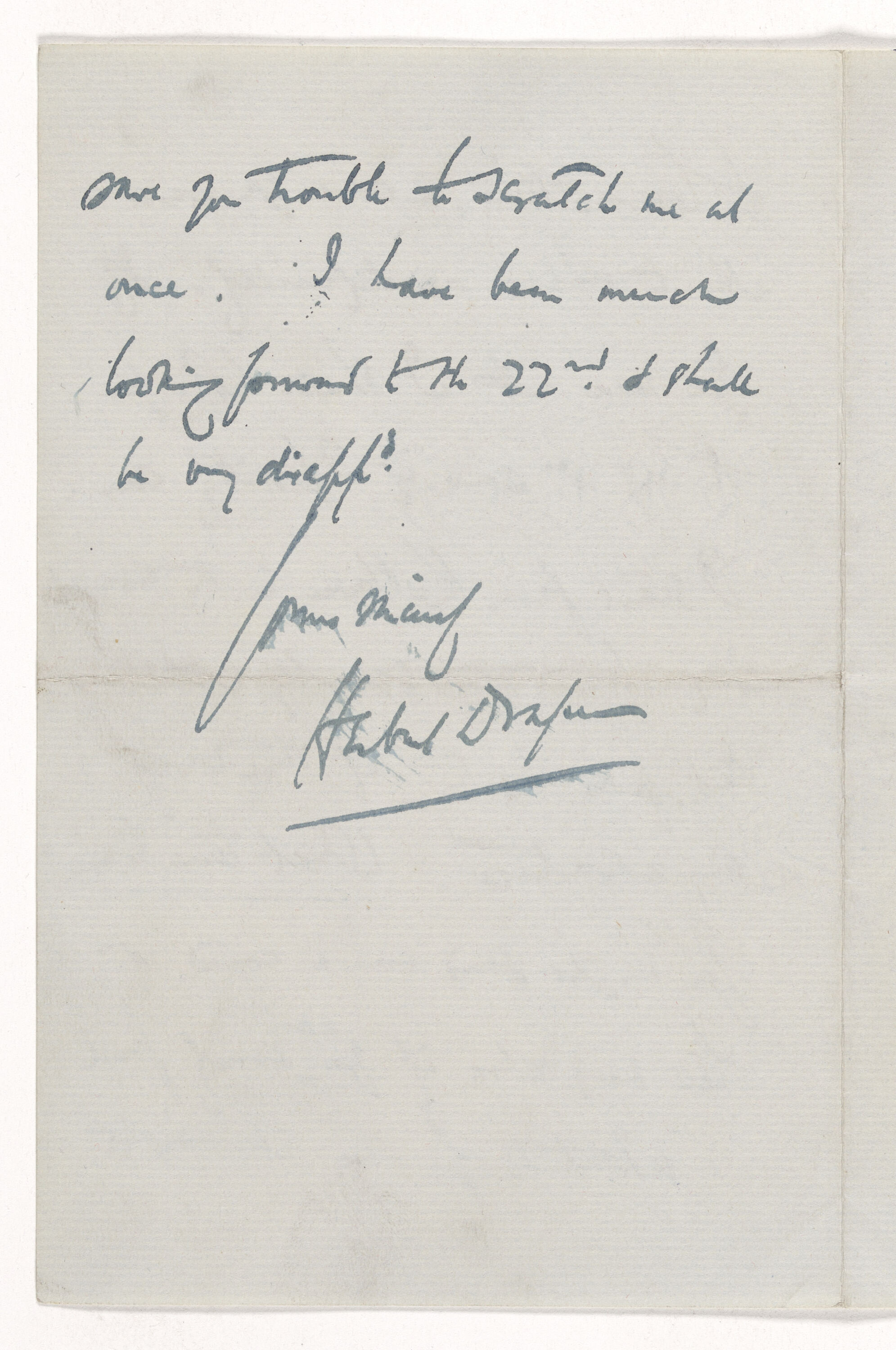
I have managed to take a Thundering cold & have been doing all I can to cure it since Saturday but it wont budge, in fact I am on my way to bed now (3 p.m.) after a morning’s work. … I have been much looking forward to the 22ⁿᵈ & shall be very disappᵈ.

Rare Book & Manuscript Library, University of Illinois at Urbana-Champaign, William Allingham Papers, box 6, folder 28 · archive record

The archive’s catalogue dates the letter ‘19uu’ and names the folder ‘Draper, Herbert James to John Arthur Lomax, 1903’. On 21 September 1903, on the same letterhead, Draper accepted Lomax’s invitation to play in a match and asked to be kept in reserve, ‘as one you can scratch off the team’ (archive record, the envelope postmarked 26 September 1903); here he writes ‘scratch me at once’. He hopes to ‘pull round by Thursday’ (page 2) and has been looking forward to ‘the 22nd’: after 21 September the first Thursday to fall on the 22nd is 22 October 1903, and the Tuesday before it is the 20th.

Room V ‘Home’, 1899–1919: four works

Draper’s letter to Lomax, page 1
As written: the letter to Lomax, page 1 — Rare Book & Manuscript Library, University of Illinois. The sheet at full size
Draper’s letter to Lomax, page 4
As written: page 4 — Rare Book & Manuscript Library, University of Illinois. The sheet at full size

15 Abbey Road, St John’s Wood, 4 May 1914 · to Philip de László

My dear Laszlo I am told there is to be an election at the Royal Portrait Soc: on May 20. If you attend the meeting & are able to give me a vote I should think it very kind of you. Do not trouble to reply.

The de László Archive Trust, letter 004-0009; the original is in the National Portrait Gallery, London · archive record

Room V ‘Home’, 1899–1919: four works

The image of the sheet is in the de László Archive, which reserves all rights to it, so it is not reproduced here. The words have been checked against it.

15 Abbey Road, St John’s Wood, 10 January 1915 · to Philip de László

My dear Laszlo I am told there is to be an election this week to the Rl. Portᵗ. Soc. I do not know whether you mean to attend, but if you do, & feel you can spare me any support, I should think it very kind of you as I am a candidate for election to that Society. … This time, I understand, there really is to be an election.

The de László Archive Trust, letter 004-0008; the original is in the National Portrait Gallery, London · archive record

The last line is a postscript below his signature. The de László Archive, on both letters: ‘Based on the RP’s membership lists, it does not appear that Draper was successful in his bid for election’.

The image of the sheet is in the de László Archive, which reserves all rights to it, so it is not reproduced here. The words have been checked against it.

What these pages add · Addita

Measured against the dossier of this exhibition and the literature printed by Christie’s. Simon Toll’s monograph of 2003 could not be consulted, and any of what follows may already stand in it.

  1. The text of 1906The words that Christie’s quoted in 2003, one sentence long and without a reference, as Draper’s letter to the Academy are printed in full in Academy Notes for 1906, p. 27, in quotation marks; the preface to that issue says that the notes were in many instances compiled from material furnished by the artists themselves.
  2. The mythDaphne as the dawn is Max Müller’s reading, printed in 1856: there she flies from Apollo and dies in his rays. In Draper’s text the Dawn is absorbed ‘willingly’, as in the Vedic verse Müller sets beside it: ‘The Dawn comes near to him’.
  3. Leighton’s letterThe picture painted in Rome before Draper asked Leighton’s advice is no. 891 at the Academy of 1892, Love in the garden of Philetas: his only work there that year.
  4. The letter to LomaxUndated in the archive’s catalogue, it falls on Tuesday 20 October 1903, by the match, the Thursday and the 22nd it names.
  5. The election of 1914The postscript of January 1915, ‘This time, I understand, there really is to be an election’, suggests that the election he wrote of in May 1914 did not take place.

What is not known · Quaestiones

Under each question, the record that could answer it.

  1. The sheet of 1906Does the text survive in his hand, and did Christie’s quote it from the sheet or from Academy Notes?The Royal Academy’s archive; Toll, 2003.
  2. IcarusDid he give words of his own for The Lament for Icarus, shown at the Academy in 1898?Academy Notes for 1898, which the Internet Archive does not hold.
  3. Leighton’s letterDoes the letter itself survive?Draper’s papers; Baldry’s papers.
  4. The morning’s workWhat was he painting in October 1903? At the Academy of 1904 he showed, among other works, The Golden Fleece and Sea Melodies, for which no. 10 is a study; the letter names no picture.The Academy’s catalogue of 1904; Toll, 2003.

Sources

Draper’s text of 1906 and the preface are from Academy Notes for 1906, from the Getty Research Institute’s copy in the Internet Archive; the entry of 1892 is from Academy Notes for 1892 (Internet Archive); Max Müller’s essay from Oxford Essays, 1856 (Internet Archive); Leighton’s letter from A. L. Baldry’s article in The Magazine of Art, vol. 23 (Internet Archive). The letters to John Arthur Lomax are in the Rare Book & Manuscript Library, University of Illinois at Urbana-Champaign, William Allingham Papers, box 6, folder 28; the archive marks them as in the public domain (No Copyright – United States), and the images of the sheets are the archive’s, at full size. The letters to Philip de László are in the de László Archive, letters 004-0009 and 004-0008; the archive reserves all rights to its images, which are not reproduced here. The words have been checked against the pages and the sheets; dates in square brackets are ours. The detail of Day and the Dawn Star is the one in the dossier.

How to cite

After The Chicago Manual of Style (18th edn, 2024), in the form used in art-historical publications.

Note
“Letters. Supplementary material to the exhibition What Song the Syrens Sang,” Lacrimae Rerum Gallery, LR 9, accessed 15 November 2026, https://lacrimaererum.art/draper/what-song-the-syrens-sang/litterae/.
Bibliography
Lacrimae Rerum Gallery. “Letters. Supplementary material to the exhibition What Song the Syrens Sang.” LR 9. Accessed 15 November 2026. https://lacrimaererum.art/draper/what-song-the-syrens-sang/litterae/.